
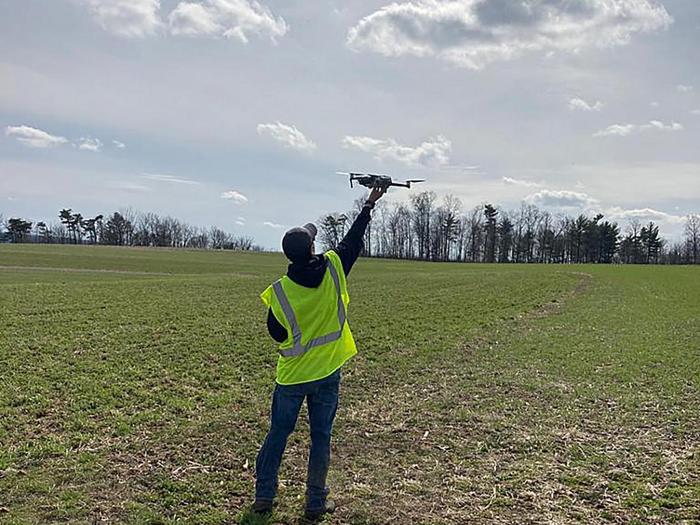
Researchers at Penn State have developed a drone-based mapping system capable of matching the performance of far more expensive agricultural surveying technologies, offering farmers and environmental managers a cheaper way to monitor runoff and pollution risks.
The study, published ahead of the June edition of the journal Computers and Electronics in Agriculture, demonstrates that drone photography combined with photogrammetry can produce highly accurate 3D maps used to identify hydrologically sensitive zones and phosphorus pollution hotspots on farmland.
Scientists explained that these areas are critical for precision agriculture because they reveal where water tends to accumulate or flow, increasing the risk of fertilizer and manure runoff into nearby streams and ecosystems.
Traditionally, such mapping relies on LiDAR technology, a sophisticated remote-sensing system that uses laser pulses from aircraft or satellites to generate terrain models. While highly accurate, LiDAR remains costly and is not always easily accessible for agricultural operations.
The research team tested its drone-based method across four farm sites in eastern Pennsylvania and compared the results with existing LiDAR datasets. According to the findings, the drone-generated maps showed almost identical results, with differences below 1.53%.
Researchers used a process known as “Structure from Motion” photogrammetry, which combines hundreds of overlapping aerial photographs captured by drones to reconstruct detailed three-dimensional landscape models.
The study highlighted that the new approach could help farmers, watershed managers and environmental agencies update land analysis much faster without waiting for new LiDAR flights, particularly in regions where landscapes frequently change due to farming activities or infrastructure work.
The researchers also noted that nutrient pollution often originates from a limited portion of agricultural land, making accurate mapping essential for improving water protection strategies and targeting environmental interventions more effectively.