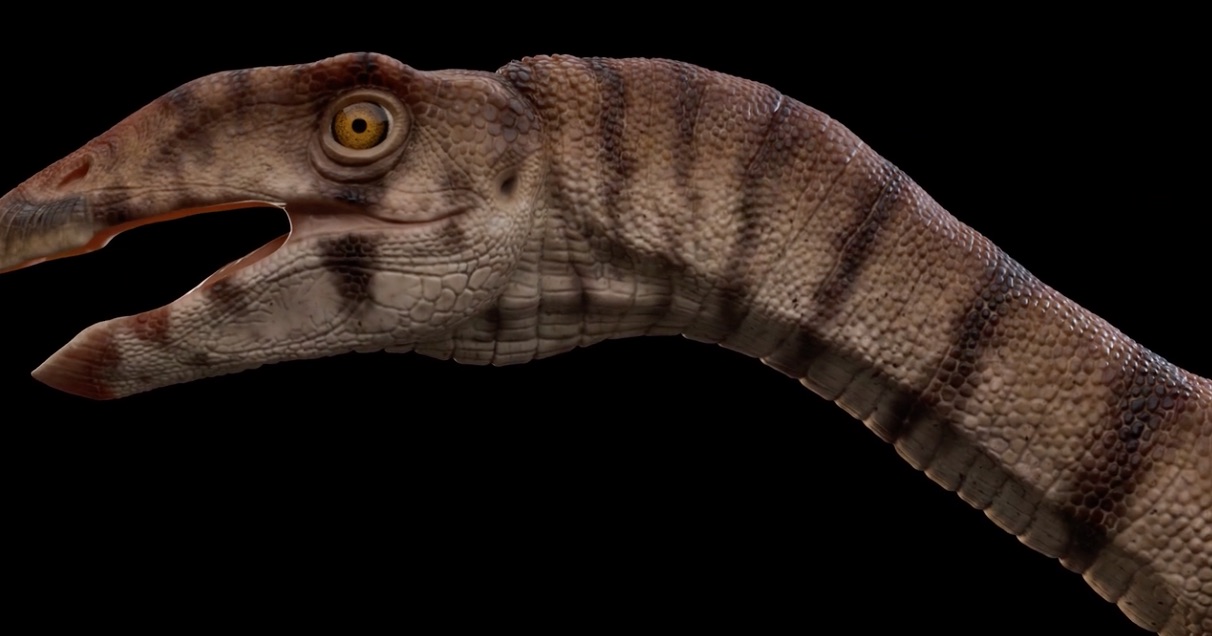
Paleontologists in the United States have identified a strange new prehistoric reptile species that looked more like an ostrich-like dinosaur than a crocodile ancestor. Named Labrujasuchus expectatus, the newly discovered creature roamed Earth during the Late Triassic period and was unearthed at the famous Ghost Ranch fossil site in New Mexico.
The species belonged to a rare group of ancient crocodile relatives known as shuvosaurids, but unlike modern crocodiles, it walked on two legs, had tiny forelimbs and possessed a completely toothless beak-like mouth. Researchers say the animal’s body structure closely resembled ornithomimosaur dinosaurs, despite evolving from a completely different reptile lineage.
The discovery was published in the Journal of Vertebrate Paleontology and is being described as another example of convergent evolution, where unrelated species independently develop similar physical traits. Scientists involved in the study noted that the Triassic period was filled with unusual evolutionary experiments long before dinosaurs dominated the planet.
According to researchers from the Natural History Museum of Los Angeles County, the fossil fills an important evolutionary gap between previously discovered species from the same region. The genus name “Labrujasuchus” references the historic Spanish nickname “Ranchos de los Brujos” — or Ranch of the Witches — once associated with Ghost Ranch.
The fossil was uncovered as part of a long-running excavation project at Ghost Ranch, a site internationally known for its exceptionally preserved Triassic fossils and its connection to the paintings of Georgia O’Keeffe. Scientists say the discovery helps expand understanding of how reptiles evolved during one of the most transformative periods in Earth’s history.