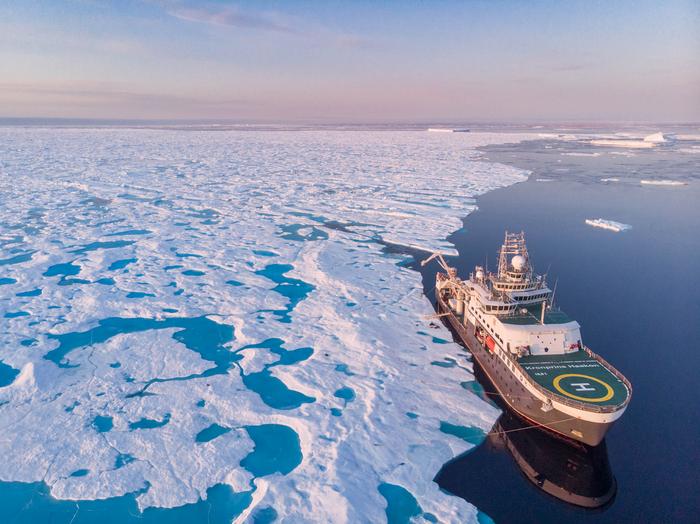
A major scientific study has revealed that the Arctic Ocean has undergone a profound and potentially irreversible transformation, raising new concerns about the future of marine ecosystems and global climate stability. Researchers say the region crossed a critical tipping point around 2009, triggering changes that are now disrupting the Arctic food chain.
The findings, published in the journal Communications Earth & Environment, show that the rapid decline of Arctic sea ice has significantly reduced concentrations of nitrate, a nutrient essential for the growth of phytoplankton. These microscopic organisms form the foundation of the Arctic marine food web, supporting fish, seabirds and marine mammals.
Scientists from University of Edinburgh analyzed more than two decades of oceanographic data collected in the Fram Strait, a key passage linking the Arctic Ocean and the Atlantic. Their research identified a steady decline in nitrate levels beginning in 2009, coinciding with an accelerated loss of sea ice across the Arctic.
According to the study, the disappearance of ice has exposed vast shallow coastal areas to sunlight, intensifying a natural process known as benthic denitrification. This process converts nitrate into nitrogen gas, effectively removing the nutrient from seawater and reducing its availability for marine life.
Researchers warn that lower nitrate levels could fundamentally alter Arctic ecosystems. The ocean may increasingly favor smaller plankton species, reducing the amount of food available to larger organisms higher up the food chain. Such changes could eventually affect commercial fisheries in the North Atlantic and reshape marine biodiversity across the region.
The consequences may extend beyond wildlife. Phytoplankton play a crucial role in absorbing carbon dioxide from the atmosphere through photosynthesis. A decline in their productivity could weaken the Arctic Ocean’s ability to act as a carbon sink, potentially amplifying the effects of climate change.
Lead researcher Marta Santos-García said the Arctic appears to have shifted from an ecosystem primarily limited by light availability to one increasingly constrained by nitrate scarcity. The discovery challenges previous assumptions that sea-ice loss would automatically stimulate marine productivity by allowing more sunlight to reach surface waters.
The international research team concludes that, because the shift is closely tied to ongoing sea-ice decline, the Arctic Ocean is unlikely to return to its previous state. Scientists are now calling for closer monitoring to understand how these changes will cascade through marine food webs and influence ocean ecosystems far beyond the Arctic itself.