Astronomers using the James Webb Space Telescope have uncovered dramatic daily weather cycles on a giant exoplanet located nearly 700 light-years from Earth, offering one of the clearest views yet into the atmosphere of a world beyond the Solar System.
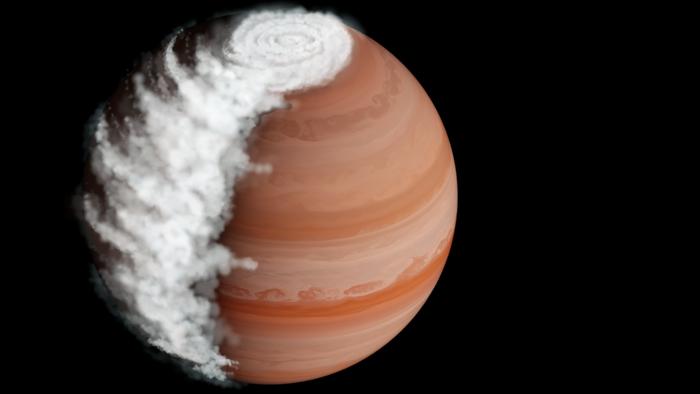
The discovery focuses on WASP-94A b, a so-called “Hot Jupiter” orbiting extremely close to its host star in the Microscopium constellation. Researchers from Johns Hopkins University found that the planet experiences a striking contrast between morning and evening atmospheric conditions, with thick mineral clouds forming at dawn before disappearing later in the day.
Using the advanced capabilities of the James Webb Space Telescope, scientists were able to separately analyze different regions of the planet as it passed in front of its star. The observations revealed that the morning side of the planet is covered by clouds made of magnesium silicate, while the evening side remains largely clear.
According to the research team, the phenomenon may be caused either by powerful atmospheric winds transporting clouds across the planet or by intense daytime heat vaporizing them entirely. Temperatures on the dayside exceed 1,000 degrees Celsius, creating extreme atmospheric conditions unlike anything seen on Earth.
The findings represent a major breakthrough for exoplanet science because clouds have long complicated efforts to study distant planetary atmospheres. Scientists often compared the challenge to trying to observe a landscape through a fogged-up window. By isolating the cloud activity, researchers were finally able to obtain a far more accurate understanding of the planet’s chemical composition.
The new observations also overturned earlier assumptions about WASP-94A b. Previous data suggested the planet contained unusually high levels of oxygen and carbon, but the latest analysis indicates its composition is much closer to Jupiter than originally believed.
Researchers say the study could significantly improve understanding of atmospheric physics and cloud formation on giant exoplanets. After examining WASP-94A b, the team identified similar cloud cycles on two additional gas giants, WASP-39 b and WASP-17 b, suggesting the phenomenon may be more common than previously thought.
The study was published in the journal Science and is expected to contribute to future efforts aimed at studying more complex exoplanet atmospheres, including planets located within habitable zones around distant stars.