
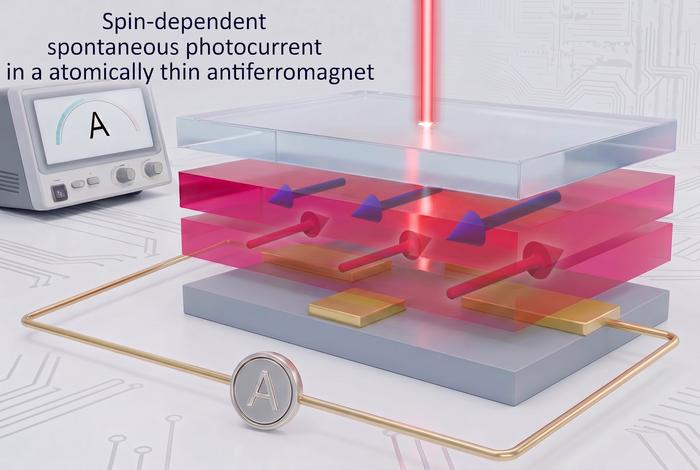
Scientists from The University of Tokyo have discovered a new type of photocurrent capable of reflecting magnetic states inside an atomically thin antiferromagnetic material, a breakthrough that could accelerate the development of next-generation quantum and ultra-low-power electronic technologies.
The research focused on a two-layer antiferromagnetic material in which spins are aligned within each atomic layer while remaining opposite between the upper and lower layers. Researchers observed that light exposure generated an electrical current without applying external voltage, but only when the material was in a magnetic state. Remarkably, the direction of the photocurrent reversed depending on the magnetic configuration of the layers.
According to the team, this behavior demonstrates for the first time that antiferromagnets without visible macroscopic magnetization can still generate photocurrents carrying information about their magnetic states.
The study also revealed that the phenomenon is linked to the quantum geometric properties of electronic wavefunctions, uncovering a previously unexplored mechanism for photocurrent generation in magnetic materials.
Using specially designed devices, researchers showed that the photocurrent flows locally within individual atomic layers and can be selectively extracted by modifying the device structure. This layer-specific control is considered particularly promising for future opto-spintronic systems and advanced quantum electronics.
The findings could help pave the way for faster and more energy-efficient information processing technologies, especially as industries increasingly explore atomically thin materials for future computing architectures.
The study was published in the journal Nature Materials.