A breakthrough discovery by an international team of astronomers has brought scientists closer to solving one of the most intriguing mysteries in modern astrophysics. Researchers have identified the source of a rare class of cosmic signals that have puzzled experts for years, opening a new window into some of the most extreme environments in the universe.
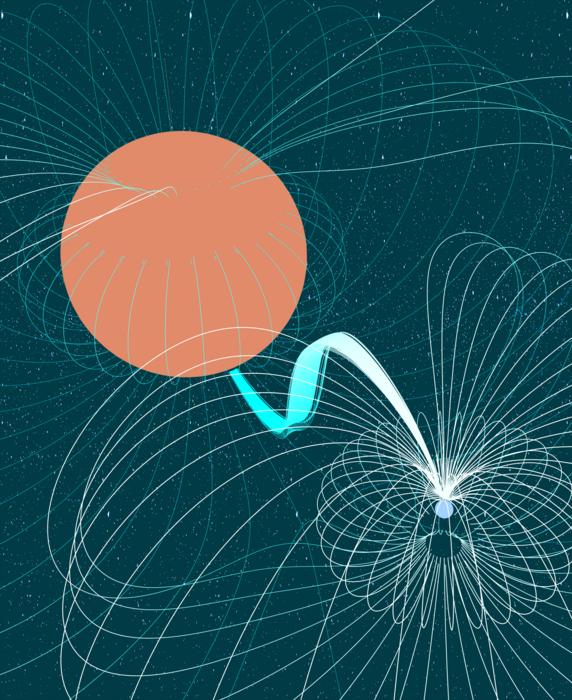
The discovery centers on a stellar system known as ASKAP J1745−5051, located within our galaxy and detected using the powerful ASKAP radio telescope operated by CSIRO. The system consists of a dense white dwarf star drawing material from a nearby red dwarf companion, creating powerful bursts of radio waves and X-rays that repeat every 1.4 hours.
Scientists led by researchers from University of Sydney say the finding provides the clearest evidence yet for the origin of so-called long-period radio transients, a mysterious category of signals first observed in only a handful of locations across the Milky Way. Until now, astronomers had struggled to determine what produced these unusual emissions.
The newly identified system operates under extraordinary conditions. As gas from the red dwarf spirals toward the white dwarf, it heats up dramatically and emits X-rays. At the same time, interactions between the magnetic fields of both stars generate intense radio bursts. Researchers found that the radio and X-ray emissions peak at different times, suggesting they originate from separate regions within the binary system.
The discovery challenges earlier theories that linked long-period radio transients to slowly rotating neutron stars. Current models indicate that neutron stars spinning at such slow rates should not be capable of producing these signals. The new observations instead support the idea that some of these enigmatic emissions are generated by binary star systems involving accreting white dwarfs.
Researchers describe ASKAP J1745−5051 as a potential “Rosetta Stone” for future studies of cosmic radio transients. By providing a confirmed example of how these signals are created, the system could help astronomers classify other mysterious radio sources discovered throughout the galaxy.
Beyond solving a long-standing astronomical puzzle, the stellar pair offers scientists a unique natural laboratory for studying plasma behavior, magnetic interactions and gravity under conditions that cannot be recreated on Earth. Future observations using radio, optical and X-ray telescopes are expected to reveal even more about the mechanisms powering these remarkable cosmic events.
The research was published in the journal Nature Astronomy and involved scientists from Australia, the United States, Canada, China, Spain and Israel, highlighting the growing international effort to understand the universe’s most unusual phenomena.