Scientists studying the massive 2022 eruption of the Hunga Tonga–Hunga Ha’apai volcano have discovered that the volcano may have partially cleaned up its own methane pollution, a phenomenon researchers say could inspire future technologies aimed at slowing global warming.
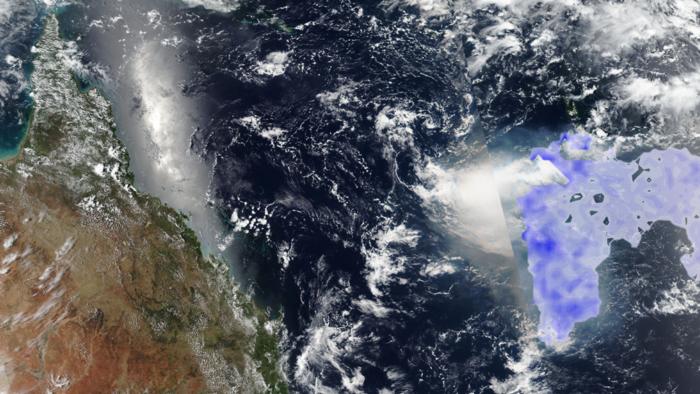
The underwater volcano in the South Pacific produced one of the most powerful eruptions in modern history, releasing huge quantities of gas, ash and seawater high into the atmosphere. But while analyzing satellite data, researchers detected unusually large concentrations of formaldehyde inside the volcanic plume — a key sign that methane was actively being broken down in the atmosphere.
Scientists tracked the cloud for more than a week as it traveled across the Pacific toward South America. Because formaldehyde survives only briefly in the atmosphere, researchers concluded that methane destruction was occurring continuously inside the volcanic plume.
According to the study, sunlight reacting with a mixture of volcanic ash, sea salt and seawater likely generated highly reactive chlorine atoms capable of breaking down methane molecules. Researchers say the mechanism resembles a similar chemical process previously observed with Saharan dust particles over the Atlantic Ocean.
Methane is considered one of the most powerful greenhouse gases and is responsible for roughly one third of global warming. Although it remains in the atmosphere for a shorter time than carbon dioxide, its warming effect is far stronger over a twenty-year period.
Scientists believe the findings could eventually help researchers develop artificial methods to accelerate methane removal from the atmosphere. They also say satellite monitoring may become a critical tool for verifying whether future climate technologies are effectively reducing methane levels.
The research was carried out using the TROPOMI instrument aboard the European Space Agency’s Sentinel-5P satellite and was published in the journal Nature Communications.