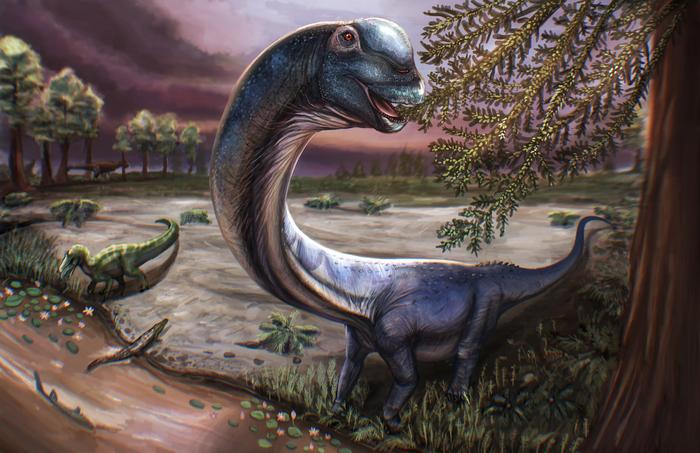
A team of international researchers has identified the largest dinosaur ever discovered in Southeast Asia, unveiling a massive new species named Nagatitan chaiyaphumensis after fossils were unearthed in northeastern Thailand.
The discovery was led by scientists from University College London alongside researchers from Mahasarakham University, Suranaree University of Technology and the Sirindhorn Museum. The findings were published in the journal Scientific Reports.
Researchers estimate the giant long-necked herbivore measured around 27 metres in length and weighed approximately 27 tonnes — roughly equivalent to nine adult Asian elephants. The dinosaur was identified from spine, pelvis, rib and leg bones discovered near a pond in Chaiyaphum province about a decade ago.
The species belonged to the sauropod family, a group of enormous plant-eating dinosaurs that included Diplodocus and Brontosaurus. Scientists believe Nagatitan lived between 100 and 120 million years ago during the Early Cretaceous period.
Lead author Thitiwoot Sethapanichsakul described the dinosaur as the “last titan” of Thailand because it was found in the country’s youngest dinosaur-bearing rock formation, suggesting it may be one of the last giant sauropods to inhabit the region before rising sea levels transformed the landscape into shallow seas.
The research team says the ancient environment was likely arid to semi-arid, crossed by river systems populated by fish, crocodiles and freshwater sharks. Nagatitan would have shared its habitat with smaller herbivorous dinosaurs, giant carnivores and flying reptiles known as pterosaurs.
Scientists also confirmed the species belonged to a rare Asian subgroup of sauropods called Euhelopodidae, helping researchers better understand dinosaur evolution across Southeast Asia.