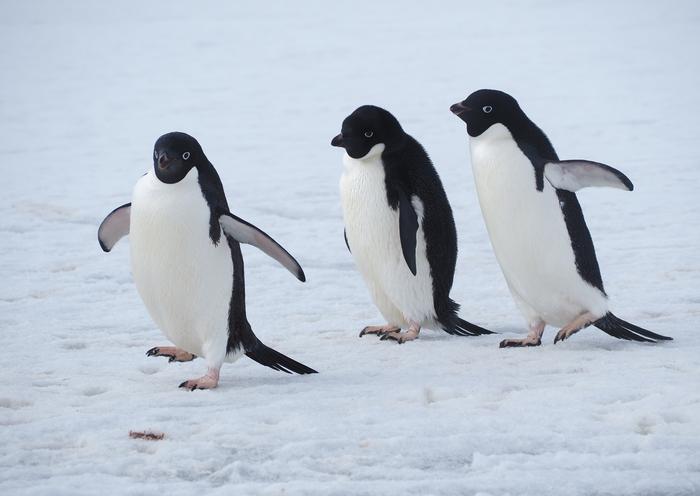
When food becomes scarce in the harsh environment of Antarctica, Adélie penguins appear to rely on more than instinct. New research reveals that these seabirds learn from one another, using social information to identify promising feeding grounds and improve their chances of success during the breeding season.
Scientists monitored a large portion of an Adélie penguin colony in Lützow-Holm Bay, Antarctica, using advanced GPS and biologging technology. By tracking more than one-third of the colony’s breeding adults, researchers collected detailed data from hundreds of foraging trips, providing an unprecedented view of how penguins search for food.
The findings show that penguins often return to areas where they previously found food, demonstrating the importance of personal experience. However, the study uncovered another crucial behavior: many birds leave the colony alongside other penguins and travel together toward feeding zones. By doing so, they gain access to valuable information about locations recently visited by their companions.
Researchers discovered that penguins that experienced poor hunting results were significantly more likely to change their destination during subsequent trips. Instead of relying solely on their own experience, these less successful birds appeared to follow and learn from fellow colony members that may have located richer feeding grounds.
This behavior reflects what scientists describe as a “win-stay, lose-shift” strategy. Penguins that successfully find food tend to return to the same area, while those that fail seek alternatives by drawing on information obtained from other birds. Such flexibility could help maximize food collection during the demanding chick-rearing period, when parents must repeatedly travel between the colony and the ocean.
The study also highlights a broader ecological role played by penguin colonies. Beyond providing protection and breeding opportunities, colonies may function as information-sharing networks where individuals indirectly exchange knowledge about food availability and environmental conditions.
Researchers believe the discovery could improve scientific understanding of why many animal species continue to live in large social groups despite the increased competition and disease risks associated with colonial life. The findings suggest that access to shared information may be one of the key evolutionary advantages that offsets these costs.
Future studies will investigate whether similar information-sharing mechanisms exist in larger colonies and across different environments. As climate change continues to reshape marine ecosystems, understanding how animals adapt their foraging strategies may become increasingly important for predicting the resilience of wildlife populations.
The research was published in the journal *Proceedings of the Royal Society B*, offering new insights into the sophisticated social behavior of one of Antarctica’s most iconic species.