A hidden mathematical connection between origami and structural engineering is opening a new path for designing complex, irregular shapes—without the usual computational burden. Researchers at Princeton University have demonstrated that two seemingly different systems—origami folding and tensegrity structures—are governed by the same underlying equations.
This discovery allows engineers to bypass one of the biggest challenges in design: handling irregular, non-symmetric structures. Unlike simple forms such as cubes or spheres, natural shapes—like termite mounds or human bones—require large sets of variables and complex calculations to model. The new approach changes that equation entirely.
By leveraging what researchers call “invariant dual mechanics,” designers can start with a simple, symmetrical structure whose mechanical properties are already known—such as stability or flexibility—and transform it into a more complex, irregular form. Crucially, the essential properties remain predictable, eliminating the need for repeated simulations and heavy computation.
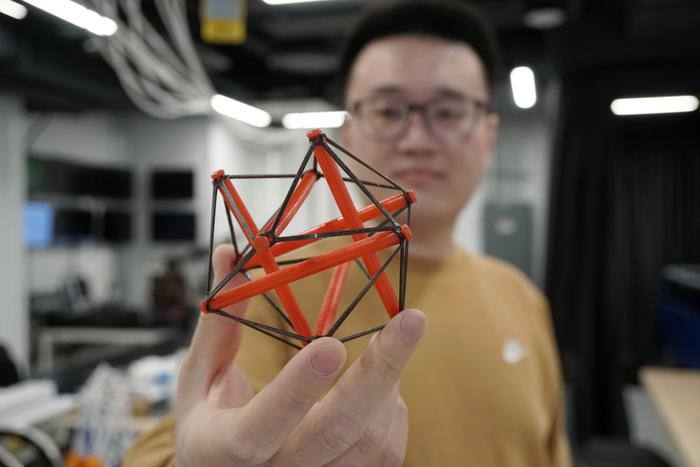
The breakthrough bridges two fields. Origami focuses on how surfaces fold along precise geometric patterns, while tensegrity describes systems stabilized by a balance between tension and compression, such as skeletal structures. The realization that both share the same mathematical foundation enables a direct translation between geometry and mechanical behavior.
In practical terms, this could reshape engineering workflows. Designers in industries ranging from automotive to robotics could rapidly prototype new forms by adjusting known structures rather than recalculating each variation from scratch. The approach also opens new possibilities in advanced materials, where geometry directly influences performance.
Beyond efficiency, the method introduces a more intuitive way to explore design. Engineers can now experiment with unconventional shapes—previously considered too complex—while maintaining control over their physical properties.