
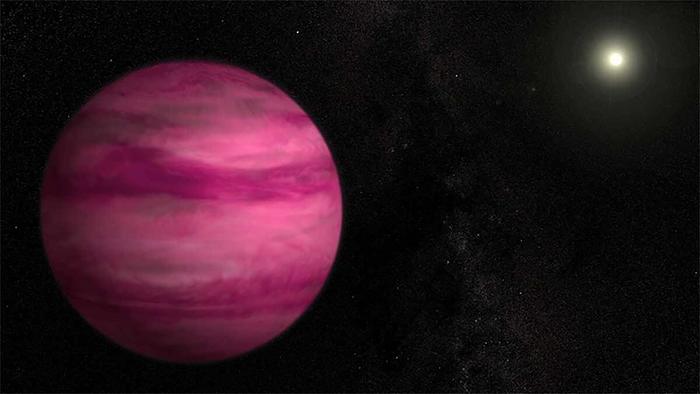
Astronomers have uncovered an extraordinary new secret hidden within one of the universe’s most unusual worlds. Using the James Webb Space Telescope (JWST), researchers have discovered vast salt clouds surrounding the famous “Pink Planet,” a cold and enigmatic object located about 57 light-years from Earth.
Known as GJ504b, the celestial body has intrigued scientists since its discovery in 2013. Its distinctive pink appearance and unusually low temperature have made it one of the most mysterious planetary-mass objects ever observed. Despite years of study, its faint light prevented astronomers from obtaining detailed information about its atmosphere using ground-based telescopes.
That challenge has now been overcome thanks to the unprecedented capabilities of the James Webb Space Telescope. By isolating the object’s faint light from the glare of its host star, researchers obtained the most detailed atmospheric analysis ever conducted on GJ504b.
The observations revealed an atmosphere rich in water vapor, methane, carbon dioxide and ammonia. However, scientists quickly realized that standard atmospheric models could not fully explain the data. The puzzle was solved when researchers introduced salt clouds into their simulations, producing a much more accurate match with the telescope’s observations.
The discovery provides some of the strongest evidence yet that salt clouds can exist in the atmospheres of extremely cold planetary bodies. Scientists had predicted such clouds for years, but direct confirmation had remained elusive.
Unlike many directly imaged giant exoplanets, which can reach temperatures exceeding 1,000 degrees Fahrenheit, GJ504b is remarkably cool at around 550 degrees Fahrenheit (290 degrees Celsius). Researchers estimate the object is between 2.5 and 4 billion years old, explaining why it has gradually cooled over time.
The findings also suggest that GJ504b contains a significant amount of heavy elements, adding another layer to the mystery surrounding its origin. Astronomers are still uncertain whether the object formed like a giant planet or more like a small star, as its mass places it near the boundary separating planets and brown dwarfs.
Beyond the discovery itself, the research demonstrates the transformative power of the James Webb Space Telescope in studying distant and faint worlds. Scientists believe the same techniques could soon be applied to investigate other cold planetary bodies whose atmospheres have remained largely inaccessible until now.
The breakthrough marks an important step in understanding the diversity of planetary atmospheres throughout the galaxy and brings astronomers closer to unlocking the secrets of some of the coldest and most elusive worlds ever discovered.