
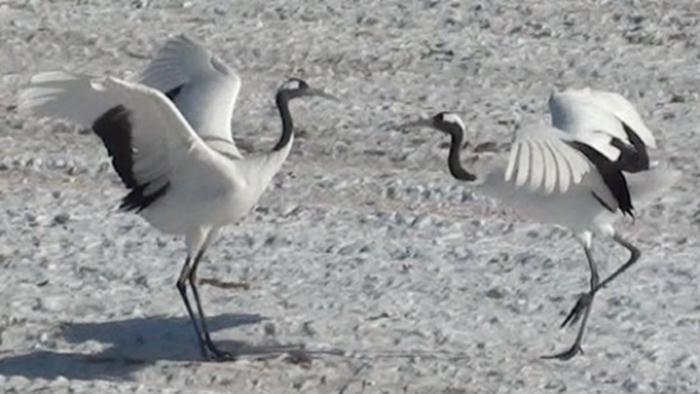
The elegant courtship dances performed by red-crowned cranes are far more sophisticated than previously understood. A new study has revealed that these displays are governed by specific behavioral sequences and precise timing, highlighting a remarkable form of two-way communication between mating partners.
Researchers from The Graduate University for Advanced Studies, SOKENDAI analyzed the pair dances of wild Red-crowned Crane in Kushiro, Hokkaido, uncovering patterns that show how males and females coordinate their movements during these iconic displays.
While animal communication has often been studied at the individual level, pair dances present a unique challenge because they emerge from the interaction of two animals acting together. The research team sought to understand how each crane responds to its partner and how these interactions shape the overall performance.
The scientists observed 21 breeding pairs and examined 99 separate dances, recording both the sequence and duration of each behavioral element. Their analysis identified three key actions — bill-stab, bow, and arch — that repeatedly structured the dances. The findings suggest that crane displays are not random performances but follow recognizable behavioral rules.
Beyond the order of movements, timing proved equally important. Researchers discovered that a crane’s next action was often influenced by its partner’s immediately preceding behavior, demonstrating a dynamic exchange of signals throughout the display. This responsiveness allows pairs to maintain coordination and create the striking synchrony for which the species is known.
The study also uncovered subtle differences between males and females. Although red-crowned cranes show little visible sexual dimorphism, males generally performed longer dances, while females appeared more likely to influence the direction and content of the interaction.
According to the researchers, the findings provide one of the clearest examples of complex bidirectional communication in animal courtship displays. Rather than simply performing predetermined routines, cranes appear to continuously adjust their behavior based on real-time feedback from their partners.
Published in the journal Animal Behaviour, the study introduces a new framework for analyzing mutual displays and coordinated signaling. The approach could eventually be applied to a wide range of species, helping scientists better understand how animals communicate through complex interactions rather than isolated actions.
The research offers fresh insight into one of nature’s most celebrated dances and suggests that successful coordination, whether among humans or cranes, depends not only on the steps themselves but also on knowing exactly when to take them.