Researchers at University College Cork have achieved a significant breakthrough in quantum physics by directly detecting elementary particles known as spinons within a quantum spin liquid, a highly unusual state of matter that has intrigued scientists for decades.
The discovery, published in the journal Nature Physics, could advance the search for materials capable of supporting future quantum computers. Scientists often describe these materials as the potential “quantum silicon” of tomorrow, drawing a parallel with the role silicon plays in modern electronics.
Unlike conventional materials that solidify as temperatures drop, a quantum spin liquid remains in a fluid-like magnetic state even near absolute zero. This behavior is driven by quantum entanglement, a phenomenon that links particles together in ways that classical physics cannot explain.
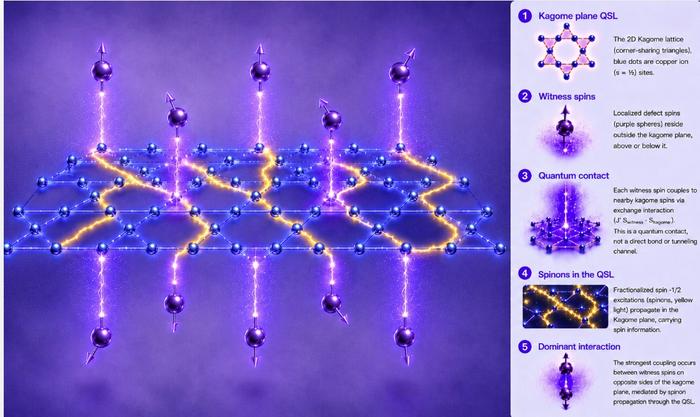
The international research team focused on Herbertsmithite, a rare mineral considered one of the strongest candidates for hosting a quantum spin liquid. Previous attempts to confirm its properties were hindered by magnetic impurities within the crystal structure, which obscured the signals researchers were trying to observe.
To overcome this challenge, the scientists developed an innovative technique called “Spin Witness Spectroscopy.” Instead of treating the impurities as unwanted interference, the team used them as quantum probes capable of revealing what was happening inside the material. By analyzing extremely small magnetic fluctuations, researchers identified interactions mediated by spinons, exotic particles that emerge only in certain quantum states of matter.
The measurements required extraordinary sensitivity. Using a superconducting quantum interference device, or SQUID, the team detected magnetic signals roughly one billion times weaker than the Earth’s magnetic field. Detailed analysis revealed a characteristic form of “pink noise,” providing evidence of the spinon-driven interactions.
The findings are attracting attention because spinons are considered important building blocks in several proposed architectures for quantum computing. Their unique quantum properties could eventually contribute to the development of topological quantum computers, a technology designed to reduce computational errors and improve scalability.
While the particles observed in Herbertsmithite are not yet the exact type required for practical quantum computing, the study provides some of the strongest evidence to date that such exotic quantum states exist naturally in minerals. Researchers believe the new spectroscopy method could also open the door to controlling these particles and exchanging quantum information with quantum materials.
The breakthrough strengthens hopes that naturally occurring quantum materials may one day provide the foundation for next-generation computing technologies, much as silicon enabled the digital revolution decades ago.