
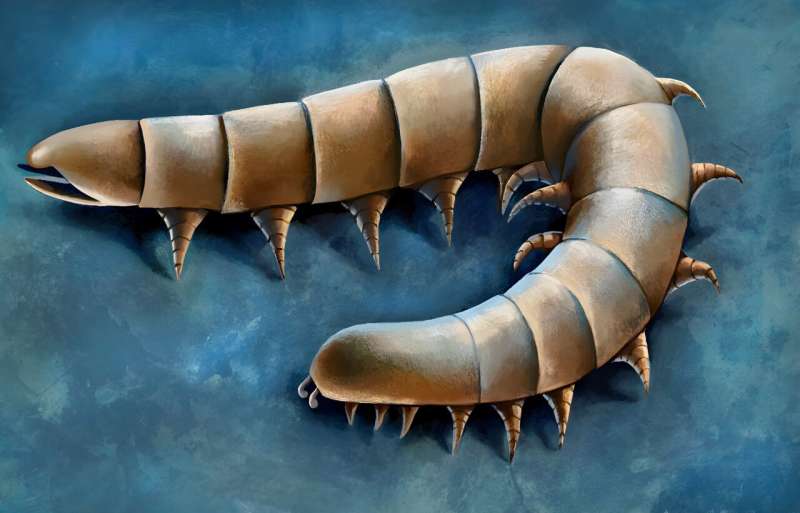
Scientists have uncovered new fossil evidence suggesting that the ancestors of modern millipedes and centipedes developed their legs while still living underwater, challenging long-standing theories about the evolution of land animals.
The discovery comes from 437-million-year-old fossils found in Wisconsin’s Silurian Brandon Bridge Formation in the United States. Researchers identified a previously unknown marine arthropod named Waukartus muscularis, a creature that already possessed multiple unbranched legs despite inhabiting shallow marine environments.
According to the study published in Proceedings of the Royal Society B, the fossil species appears closely related to the evolutionary lineage that later gave rise to myriapods, the group that includes modern millipedes and centipedes. The findings suggest that certain anatomical traits previously considered adaptations for terrestrial life may have evolved earlier in aquatic ecosystems.
Researchers say the fossils preserve rare biological details, including muscle tissues and limb structures, offering new insight into how early arthropods evolved locomotion before colonizing land. The species displayed a long segmented body with numerous pairs of legs, resembling primitive versions of modern many-legged arthropods.
The study also reshapes scientific understanding of evolutionary transitions from sea to land. Scientists now believe the loss of swimming appendages may have occurred before terrestrialization, rather than as a direct adaptation to living on land.