
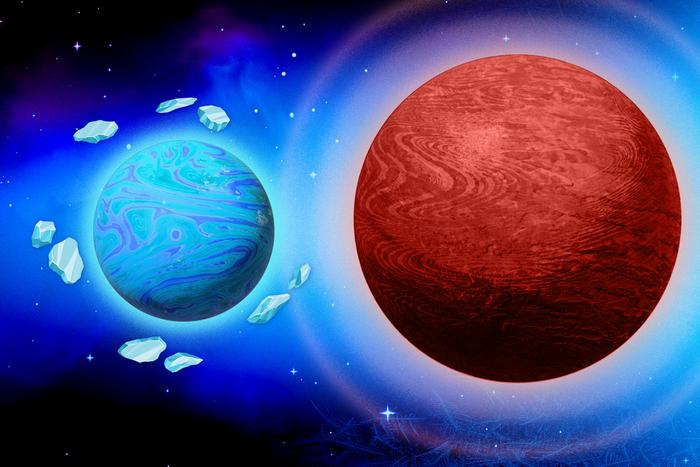
Astronomers have uncovered fresh details about one of the galaxy’s most unusual planetary systems, where a massive hot Jupiter and a smaller mini-Neptune orbit the same star in a configuration scientists once believed was nearly impossible. The discovery is giving researchers new insight into how planets can form far from their stars before slowly drifting inward over time.
Using the James Webb Space Telescope, researchers studied the atmosphere of TOI-1130b, a mini-Neptune located around 190 light years from Earth. The observations revealed large amounts of water vapor, carbon dioxide, sulfur dioxide and possible traces of methane in the planet’s atmosphere.
Scientists say these heavy molecules indicate the planet could not have formed near its current orbit. Instead, TOI-1130b likely originated in a colder and more distant region of its planetary system, beyond the so-called frost line where ice and volatile materials are abundant. Over millions of years, the planet and its hot Jupiter companion are believed to have gradually migrated closer to their host star while maintaining their unusual orbital relationship.
The findings challenge previous assumptions surrounding hot Jupiters, which are typically considered isolated giant planets whose strong gravity often ejects or destroys nearby worlds. The survival of a mini-Neptune inside the orbit of such a massive planet has therefore become a major point of interest for astronomers studying planetary evolution.
The planetary system was first identified in 2020 through observations from NASA’s Transiting Exoplanet Survey Satellite. Researchers involved in the latest study say the new atmospheric measurements provide some of the strongest evidence yet that mini-Neptunes can form in icy outer regions before migrating inward toward their stars.
The study was conducted by scientists from MIT and several international research institutions, with the results published in Astrophysical Journal Letters.