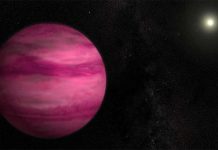
A dark, blazing world with no atmosphere—this is the emerging portrait of LHS 3844 b, a rocky exoplanet located just 48.5 light-years from Earth. Using the James Webb Space Telescope, astronomers have taken a major step beyond atmospheric studies, directly probing the surface composition of a distant planet for the first time.
Orbiting its red dwarf star in just 11 hours, LHS 3844 b is tidally locked, meaning one side permanently faces intense stellar radiation. Surface temperatures reach around 1000 Kelvin, creating an extreme environment where any atmosphere would likely have long since dissipated.
By analyzing infrared emissions with JWST’s MIRI instrument, researchers detected signals pointing to a dark, barren surface—likely composed of basaltic or magma-like rock. The data rules out an Earth-like crust rich in silicates, suggesting the planet lacks the geological processes, such as plate tectonics and water-driven recycling, that shape Earth’s surface.
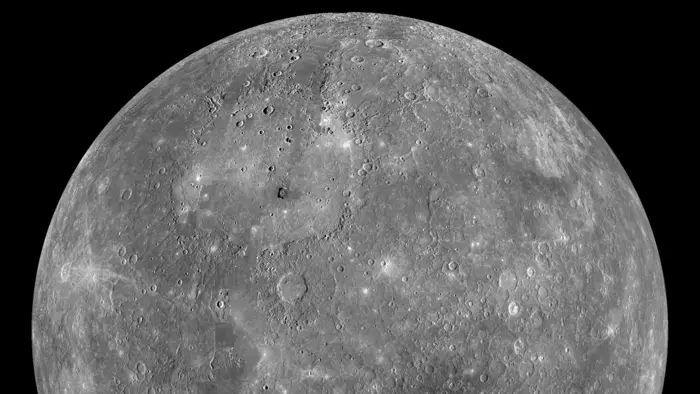
The findings, led by scientists from the Max Planck Institute for Astronomy, indicate two possible scenarios. The first envisions a relatively fresh surface formed by recent volcanic activity. The second, considered more likely, suggests an ancient, heavily weathered crust, darkened over time by radiation and meteorite impacts—similar to the surfaces of Mercury or the Moon.
Crucially, no trace of volcanic gases like sulfur dioxide was detected, weakening the case for ongoing geological activity. Instead, the evidence points toward a long period of inactivity, leaving behind a hardened, irradiated landscape.
This research opens a new frontier in exoplanet science. Rather than focusing solely on atmospheres, scientists are now beginning to decode the geology of distant worlds, using light as a proxy for surface composition. Future observations aim to refine these findings by analyzing how light reflects off different surface textures, potentially distinguishing between solid rock and fine regolith.