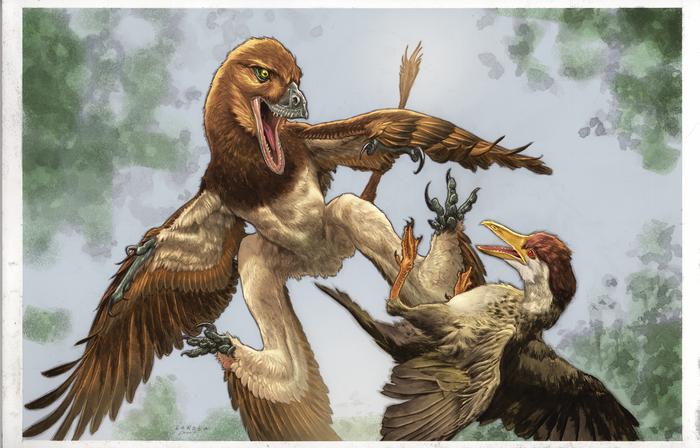
A team of paleontologists has identified a previously unknown dinosaur species that may help solve a long-standing mystery surrounding a fossil-rich region in northwestern China. The newly described predator, named Jian changmaensis, belonged to a group of feathered dinosaurs closely related to the famous Velociraptor and is believed to have glided through the air using four wing-like limbs.
The discovery was made in the Changma Basin of Gansu Province, a site renowned for its exceptional collection of Early Cretaceous bird fossils dating back around 120 million years. For years, researchers found clusters of broken bird bones at the location, some compressed into pellet-like masses resembling those produced by modern birds of prey. However, no clear predator had been identified until now.
Scientists believe Jian changmaensis may have been responsible for hunting these ancient birds. Unlike the numerous avian fossils uncovered in the basin, this specimen represents the only known non-bird dinosaur discovered at the site. Its carnivorous nature and comparatively larger size make it a strong candidate for the predator behind the mysterious bone accumulations.
The new species belongs to the microraptor lineage, a branch of small feathered dromaeosaurs closely related to birds. While only part of the dinosaur’s upper arm has been recovered, researchers estimate it possessed a wingspan of approximately four feet, comparable to that of a modern barn owl. The fossilized arm and shoulder bones also suggest it carried long feathers on both its forelimbs and hind limbs, giving it a distinctive four-winged appearance.
According to the research team, Jian changmaensis was unlikely to achieve powered flight. Instead, it probably moved through forested environments by gliding from tree to tree, similar to modern flying squirrels. This aerial ability may have provided an advantage when pursuing small prey, including primitive birds inhabiting the region.
The dinosaur’s name combines references to Chinese mythology and geography. “Jian” refers to a winged creature from Chinese folklore, while “changmaensis” honors the Changma Basin where the fossil was unearthed.
Researchers say the discovery offers valuable insight into ecosystems that existed during the Early Cretaceous period and sheds new light on the evolutionary relationship between birds and their dinosaur relatives. By examining species such as Jian changmaensis, scientists hope to better understand the traits that ultimately allowed birds to survive the mass extinction that ended the age of dinosaurs.
The findings were published in the journal Annals of Carnegie Museum and involved researchers from institutions in China and the United States, including the Field Museum in Chicago and the Carnegie Museum of Natural History.