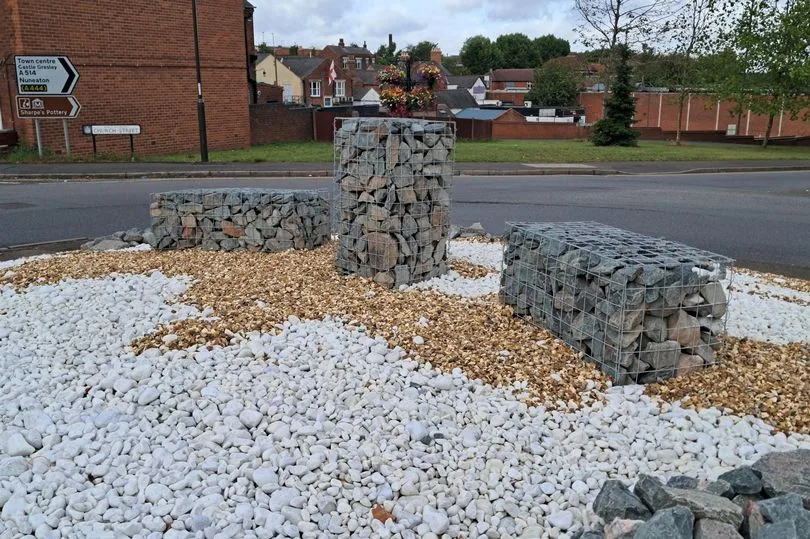
Morning commuters in Swadlincote got an unexpected jolt—not from the alarm clock, but from the roundabout at Church Street, Vicarage Road, and Civic Way. Once a simple patch of green dotted with hanging baskets, the traffic island now boasts an arrangement of white stones, brown pebbles, and stacked wire cages brimming with rocks. The transformation, funded by £8,000 of council money, has residents divided—and in some cases, openly mocking.
Dubbed “Swadhenge” by locals, the redesign has drawn comparisons to a miniature, budget Stonehenge—though opinions on its merits vary wildly. Some see it as a bold step toward urban landscaping; others call it an “ill-conceived monstrosity” and a “carbuncle” on an already busy junction.
For the council, the overhaul was a practical choice. Maintaining the former grassy roundabout posed safety challenges for staff, with no convenient parking to tend the plants. The new design, they argue, will curb weeds, support some wildlife, and eventually include additional planting in the autumn.
But residents are skeptical. “I don’t think there will be any wildlife on that—unless they are lorry spotters,” joked one local. Another added, “Why attract wildlife to the middle of a busy road? No common sense.” Beyond safety concerns, the aesthetic has divided opinion. For some, the stark stones clash with the town’s character; for others, they represent a modern, minimalistic approach to public spaces.
The council maintains that the new gabions, ornamental stones, and planned winter planting are part of a longer-term vision to make the roundabout both functional and visually interesting. Yet, as the debate rages online and in local cafés, the question remains: is Swadhenge a forward-thinking urban design—or just a costly curiosity for drivers to dodge on their daily commute?