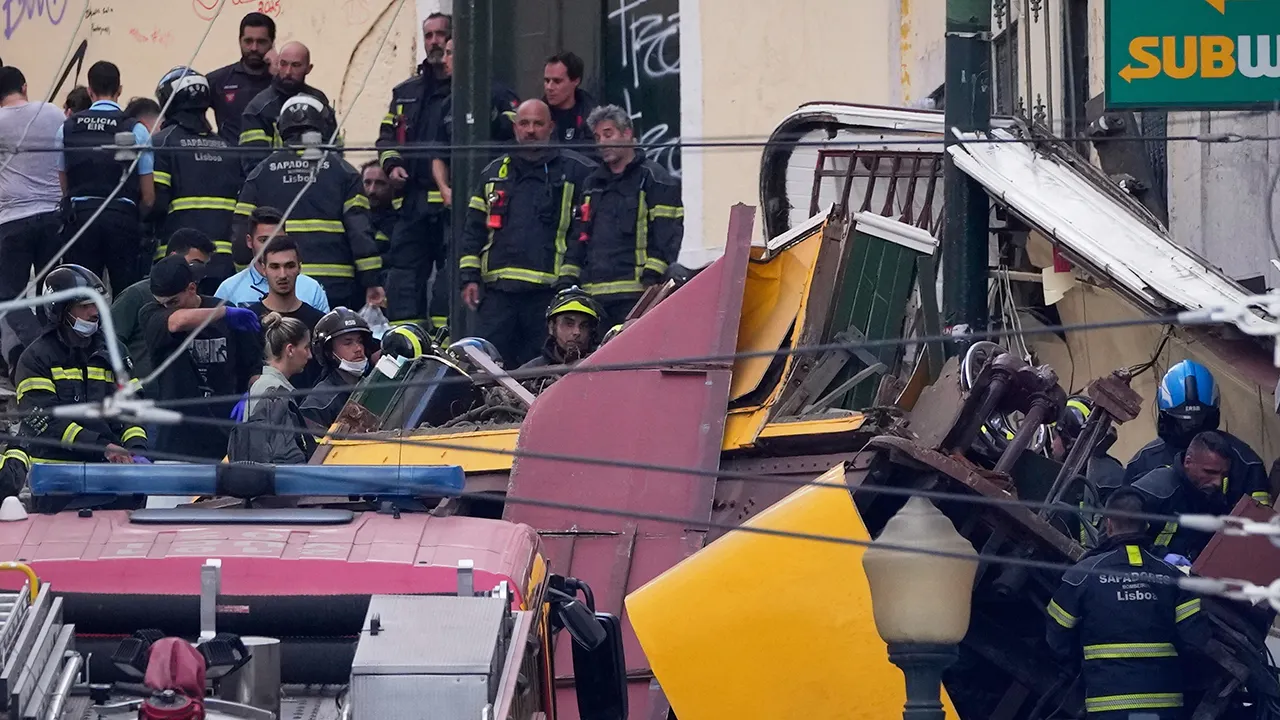
Portugal has declared a national day of mourning after one of Lisbon’s most iconic landmarks, the 140-year-old Glória funicular, derailed and crashed on Wednesday evening, leaving at least 17 people dead and around 20 others injured.
The accident occurred at approximately 18:15 local time (17:15 GMT) near Liberty Avenue, a bustling central artery of the Portuguese capital. The historic yellow cable car, beloved by tourists and locals alike, plummeted down the steep incline before slamming into a nearby building.
Authorities confirmed that several foreign nationals are among the victims, though their identities have not yet been released. Some of the injured remain in critical condition.
Lisbon’s mayor, Carlos Moedas, described the incident as “a tragic day for our city,” as rescue workers continued to search through the wreckage late into the night. Videos circulating on social media showed the carriage crumpled on the cobblestones, smoke rising into the air as bystanders fled the scene. Emergency crews worked frantically to free passengers trapped inside.
Eyewitnesses Describe “Out of Control” Descent
While the cause of the crash has not been officially determined, early reports suggest a catastrophic brake failure. Witnesses said the funicular appeared to accelerate uncontrollably down the track before smashing into a building with what one onlooker described as “brutal force.”
“It had no brakes — it collapsed like a cardboard box,” a witness told Portuguese broadcaster SIC. Another passenger recounted to the newspaper Observador that a cable may have come loose, sending the vehicle out of control.
“We all started running away because we thought it would hit the carriage below,” said Teresa d’Avó, a Lisbon resident who narrowly escaped the impact. “But instead it fell around the bend and crashed into the building.”
Investigation Underway
Lisbon prosecutors, police, and the transport accident investigation department have all launched formal inquiries into the derailment. The city’s public transport operator, Carris, which manages the funicular, said it had followed all required maintenance protocols, citing regular weekly and monthly checks. The company expressed its “deep regret” and pledged to cooperate fully with the investigation.
As a precaution, Lisbon has suspended service on its three other funicular lines pending safety inspections.
National and International Reactions
Expressions of grief poured in from across Europe. European Commission President Ursula von der Leyen extended her condolences to the victims’ families. Portuguese President Marcelo Rebelo de Sousa also visited the crash site, while Spain’s Prime Minister Pedro Sánchez said he was “appalled by the terrible accident.”
A Historic Landmark in Mourning
The Glória funicular, inaugurated in 1885 and electrified in the early 20th century, is one of Lisbon’s most recognizable attractions. Its bright yellow cars carry passengers on a short but steep 275-meter journey from Restauradores Square to the Bairro Alto district.
Beyond its tourist appeal, the funicular is a practical part of daily life in Lisbon, a city built on seven hills and reliant on its distinctive network of trams, elevators, and funiculars.
Now, the historic line — once a symbol of the city’s charm — stands as the site of one of Portugal’s deadliest urban transport disasters in recent memory.