
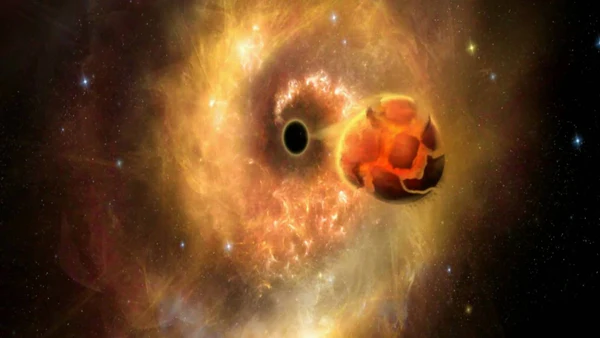
The night sky often appears calm, but beyond the reach of visible light, black holes are rewriting the script of astrophysics in the messiest way imaginable. A stellar-mass black hole recently caught in outburst has forced scientists to reconsider assumptions about how these cosmic engines feed — and what happens when their meals don’t go as planned.
When Chaos Replaces Order
The system at the center of this discovery, known as 4U 1630−472, has long been on astronomers’ radar. It belongs to a class of x-ray binaries, where a black hole siphons material from a neighboring star. Textbook models suggest the stolen gas spirals smoothly into a glowing accretion disk, some of it eventually swallowed, some blown away as orderly “disk winds.”
But when Japan’s XRISM satellite turned its Resolve instrument toward this system during a 2024 outburst, the view was anything but tidy. Instead of a predictable stream, scientists found a turbulent storm of gas flows, failed winds, and uneven outbursts — a cosmic food fight rather than a controlled meal.
Feedback in Action
Disk winds aren’t a sideshow; they are part of a critical mechanism astrophysicists call feedback. These winds help regulate how much matter a black hole consumes, and by ejecting energy back into their surroundings, they influence the growth of stars and galaxies. Understanding when and how these winds ignite is key to connecting the dots between small stellar black holes and their supermassive cousins anchoring galaxies.
The new XRISM data revealed that even at the tail end of the outburst, the black hole wasn’t settling into a quiet phase. Instead, the spectrum showed dramatic variability, hinting at gas streams overflowing their boundaries and high-speed outflows destabilizing the disk. For lead researcher Jon Miller of the University of Michigan, the surprise was a gift: “Being surprised is good. Seeing expectations proven naive means progress.”
A Telescope Built for Clarity
Older observatories like Chandra and XMM-Newton have provided decades of invaluable black hole science. But XRISM — a joint mission by JAXA, NASA, and ESA launched in 2023 — is offering a leap forward. With sensitivity more than ten times greater than its predecessors, XRISM can transform what once looked like noise into crisp, decipherable data.
This technical edge explains why the messy details of 4U 1630−472 came into focus. Spectral lines invisible for decades suddenly appeared, revealing the fine structure of winds, flows, and possible failed ejections.
Why Small Black Holes Matter
Supermassive black holes evolve on timescales far longer than a human life. Observing the rise and fall of their accretion flows directly is impossible. Stellar-mass black holes, however, flare up on a regular basis — sometimes every two years — offering real-time laboratories to study the same physical processes at play in the giants.
During outbursts, their brightness can multiply ten thousandfold in a single week, giving researchers a fast-forward view of cosmic behavior that would otherwise take millions of years to witness. “It’s like watching a condensed version of galactic evolution,” Miller explained.
Untidy, but Invaluable
What scientists expected was a graceful dimming of the accretion disk, gas flowing neatly as the system quieted. What they got instead was turbulence: mass tossed around, winds struggling to form, and flows behaving unpredictably.
As Miller put it, black holes seem to spill their meals no matter how full or empty the plate. The messiness may be frustrating for models, but it is exactly this chaos that helps unlock deeper truths about the universe.
Astronomy thrives on surprises, and in the case of 4U 1630−472, the lesson is clear: even the smallest black holes can make the biggest mess — and teach us the most.