It appeared like a whisper against the cosmic canvas — a faint smudge among the glittering stars, yet it carried secrets from beyond our solar system. Comet 3I/ATLAS, the latest interstellar traveler to sweep through our celestial neighborhood, is revealing more than just its fleeting presence: it’s offering a window into the chemistry of distant worlds.
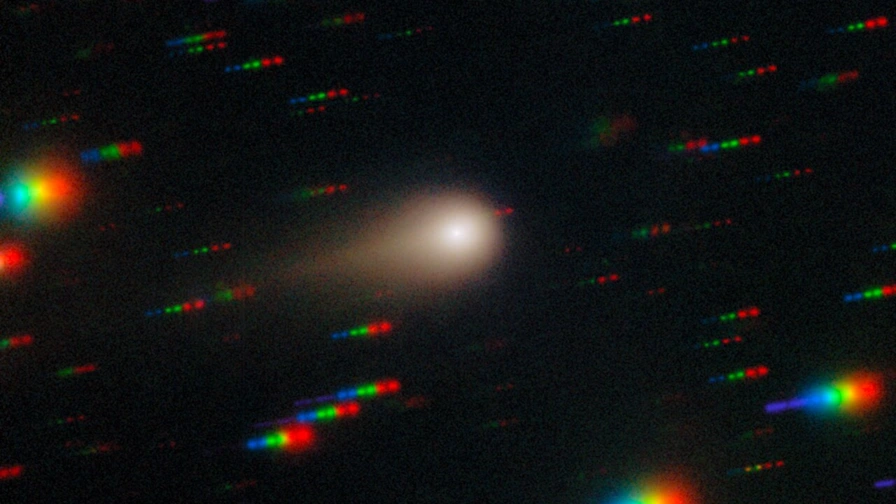
On August 27, 2025, a team of astronomers and students peered through the Gemini South telescope atop Cerro Pachón in Chile and captured images that showed a remarkable transformation. A tail was forming, extending from the comet’s nucleus, a vivid testament to the solar forces sculpting this visitor from another star system. “We were excited to see the growth of the tail, suggesting a change in the particles from the previous Gemini images,” said University of Hawaii astronomer Karen Meech, who leads the team.
A Rare Cosmic Messenger
Discovered on July 1, 2025, by the ATLAS survey, Comet 3I/ATLAS is only the third interstellar object ever detected. Its predecessors, the cigar-shaped ‘Oumuamua in 2017 and the comet-asteroid hybrid 2I/Borisov in 2019, offered tantalizing hints of alien planetary systems. Each visitor brings with it a unique opportunity to study materials formed around other stars, and 3I/ATLAS is no exception.
As it approaches the Sun, solar radiation heats the comet’s icy interior, triggering sublimation — the direct transition from solid ice to gas. The expelled material forms a glowing coma and a tail that stretches across the sky. Observations from Gemini South show that 3I/ATLAS is rapidly developing these features, giving scientists a rare chance to observe the evolution of an interstellar object in real time.
Decoding the Comet’s Composition
Beyond its spectacular appearance, the comet offers a treasure trove of scientific data. By analyzing the light it emits, researchers can identify the chemical fingerprints of particles in the coma and tail. Early spectra suggest that 3I/ATLAS shares surprising similarities with comets formed within our own solar system. This finding hints that the processes that shaped planets and asteroids around the Sun may be common in other star systems as well.
“The primary objectives of the observations were to look at the colors of the comet, which provide clues to the composition and sizes of the dust particles in the coma, and to take spectra for a direct measure of the chemistry,” Meech explained. “Seeing the tail grow confirmed a change in the particles, giving us a first glimpse into the comet’s chemistry.”
Connecting Science and Public Curiosity
This research was conducted in collaboration with the Shadow the Scientists initiative, which engages the public in authentic astronomical research. By following scientists as they capture images of interstellar wanderers like 3I/ATLAS, participants experience the excitement and rigor of space discovery firsthand.
A Cosmic Snapshot
Captured against a backdrop of multicolored stars, the comet’s wide coma and stretching tail are a visual reminder of the dynamic universe we inhabit. At roughly 1/120th of a degree across the sky, it may seem small, yet its journey spans light-years, carrying with it traces of a planetary system far from our own.
As 3I/ATLAS swings around the Sun and heads back into interstellar space, astronomers anticipate further observations in November 2025. Each snapshot offers not just a beautiful image, but a data point in understanding the diversity of worlds beyond our solar system.
“Every interstellar comet is a messenger from another star system,” said Bryce Bolin, research scientist at Eureka Scientific. “By studying their light and color, we can begin to understand the variety and complexity of planetary systems that exist across our galaxy.”
For now, 3I/ATLAS serves as both a scientific marvel and a cosmic storyteller, connecting Earth-bound observers to the distant reaches of the Milky Way — a fleeting visitor that leaves a lasting impression.