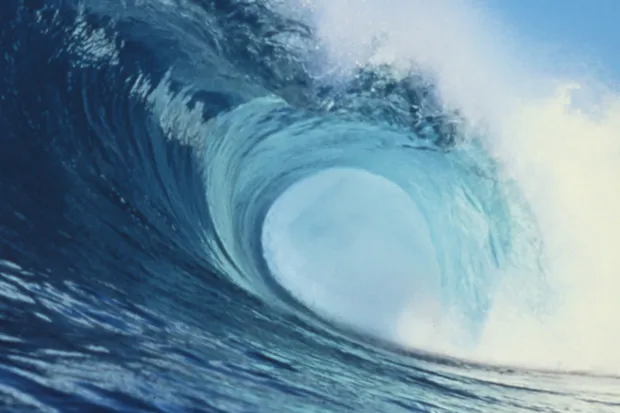
For centuries, mariners told tales of sudden, towering walls of water rising from seemingly calm seas. Many dismissed these stories as exaggerations—until January 1, 1995, when an 80-foot rogue wave struck the Draupner oil platform in the North Sea. That single event provided the first hard data of a rogue wave in the open ocean, and it changed ocean science forever.
Now, researchers at the Georgia Institute of Technology have finally cracked the mystery. An international team led by Francesco Fedele, associate professor in Georgia Tech’s School of Civil and Environmental Engineering, analyzed 27,500 wave records collected over 18 years in the North Sea. Their conclusion, published in Nature’s Scientific Reports, is that rogue waves require no mysterious forces—just the right convergence of everyday ocean behaviors.
Extraordinary Waves, Ordinary Physics
The team found that two processes are enough to create these giants:
Linear focusing – when waves moving in different directions align by chance, stacking up into a much larger crest.
Nonlinear stretching – a natural distortion that steepens the crest and flattens the trough, boosting the wave’s height by 15–20%.
Contrary to previous theories, modulational instability—where energy funnels into a single wave—was not observed in the real-world data.
“Rogue waves follow the natural orders of the ocean, not exceptions to them,” Fedele explained. “This is the most definitive evidence to date that they result from ordinary physics.”
From Understanding to Forecasting
Far from being academic, the findings carry real-world urgency. Rogue waves remain a major hazard to ships, offshore platforms, and coastal infrastructure. Current forecasting systems often treat them as unpredictable anomalies, but Fedele argues they can be modeled and anticipated.
His research is already helping organizations like NOAA and Chevron update risk models, and his team is applying machine learning to decades of wave data to identify the conditions that precede rogue waves.
“Our goal is to give forecasters tools to better predict these extreme events,” Fedele said. “Rogue waves are rare, but they’re not random. They have a fingerprint—and now, we’re learning how to recognize it.”
A Dangerous Reality
The lesson, researchers stress, is that rogue waves are not exceptions to ocean rules but expressions of them. They are extreme, but explainable.
As Fedele put it: “Rogue waves are simply a bad day at sea. They’re part of the ocean’s language—we’re just finally learning how to listen.”