When the James Webb Space Telescope first opened its eyes to the infant universe, astronomers expected distant galaxies and faint starlight. Instead, the cosmos blinked back with something stranger: tiny red pinpricks scattered across the deep sky, glowing far brighter than theory allowed.
These objects, quickly nicknamed “universe breakers,” looked too massive and too mature to exist only a few hundred million years after the Big Bang. Their brightness implied galaxies bursting with stars packed so tightly they defied known physics. Something didn’t add up.
Now, after months of analysis, a group of scientists believes the mystery may lie not in galaxies at all, but in a new kind of celestial phenomenon: black hole stars.
A New Contender in Cosmic History
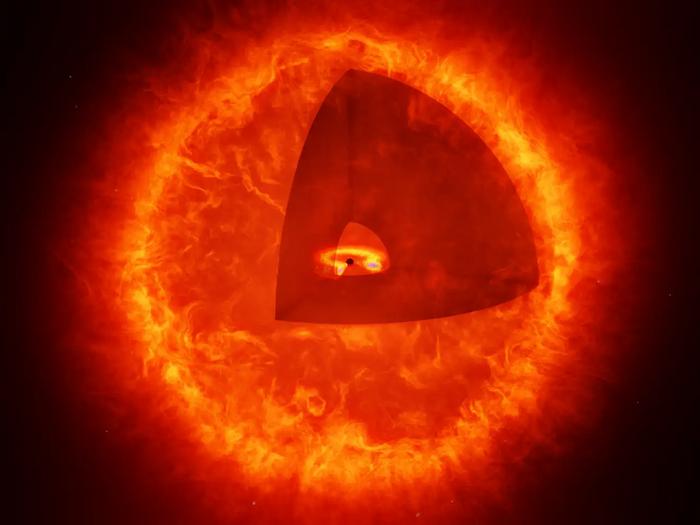
In a study published this week in Astronomy & Astrophysics, an international team led in part by Penn State researchers suggests that these “red dots” could be vast spheres of gas, lit not by nuclear fusion but by the ravenous feeding of a supermassive black hole.
Instead of stars slowly burning hydrogen, these objects would glow because matter spirals into the central black hole, releasing enormous amounts of energy. Wrapped in thick layers of gas, they would appear similar to oversized stars—yet their engines are entirely different.
“It’s an elegant answer,” said astrophysicist Joel Leja of Penn State. “We thought these were miniature galaxies crammed with stars. But what we may actually be seeing is one giant star-like structure powered from within by a black hole.”
The Test Case: The Cliff
The breakthrough came when researchers zeroed in on one especially extreme example, dubbed The Cliff. Its light traveled nearly 12 billion years before reaching Webb’s instruments, making it one of the oldest and most massive objects spotted so far.
Spectral analysis revealed that the glow wasn’t coming from countless clustered stars. Instead, it pointed to a black hole enshrouded in a dense atmosphere of hydrogen gas. In other words, not a galaxy at all, but a single colossal object.
“The extreme properties of The Cliff forced us back to the drawing board,” said Anna de Graaff of the Max Planck Institute for Astronomy. “We had to imagine an object we’d never really considered before.”
Rethinking the Birth of Black Holes
Black holes are found at the heart of nearly every galaxy, including our own. Some weigh billions of times more than our sun. How such giants formed so quickly after the Big Bang has long puzzled astrophysicists.
Black hole stars could offer the missing link. Acting as rapid mass-builders in the universe’s earliest days, they might explain how supermassive black holes came to dominate galactic centers so early in cosmic history.
“These may be the infancy stage of the black holes we see today,” said Leja. “They would grow quickly by swallowing enormous amounts of matter, cocooned in these strange atmospheres.”
Following the Clues
The Webb telescope, with its infrared instruments designed to peer back 13.5 billion years, has already transformed our view of the early universe. The discovery of these red dots—first puzzling, now potentially revolutionary—underscores how much remains unknown.
“This is the best model we have so far, but it’s only the beginning,” Leja said. “The universe keeps surprising us. Every time we think we know the rules, it reveals something we didn’t expect.”
For now, those faint red glimmers remain distant whispers from the dawn of time, challenging scientists to listen more closely—and to imagine bigger.