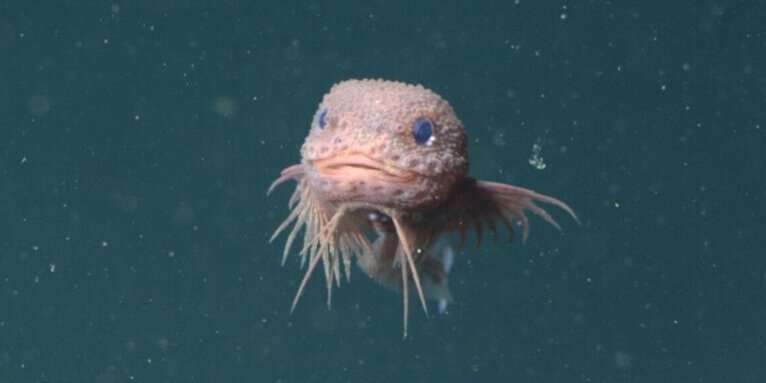
It began with a flicker of pink in the dark. Thousands of meters below the surface, a remotely operated camera swept across the seabed and caught sight of something that seemed more cartoon than creature: a lumpy, bubblegum-colored fish with oversized eyes and an almost comical number of fin rays waving like fingers.
That strange encounter in 2019 has now been confirmed as something far more significant than an odd-looking fish. It was a brand-new species of snailfish—one of three described this year by scientists who continue to peel back the mysteries of the deep.
A Trio From the Depths
Snailfish are no strangers to scientists. With more than 400 known species, they occupy waters around the globe, from shallow tide pools to the deepest trenches. Yet the three newcomers—dubbed the bumpy snailfish (Careproctus colliculi), the dark snailfish (Careproctus yanceyi), and the sleek snailfish (Paraliparis em)—underscore just how much of Earth’s largest habitat remains unexplored.
The discovery is remarkable not only for its novelty but also for its context. Two of the species were collected during the same dive at Station M, a well-studied research site in the Pacific. That such distinct fish could remain unknown in such a scrutinized corner of the ocean speaks volumes. “It highlights how much we still have to learn about our planet,” said study lead Mackenzie Gerringer of SUNY Geneseo.
Life Where Sunlight Fails
In the deep ocean, where sunlight never reaches, survival demands innovation. Colors fade into irrelevance, replaced by senses that rely on vibration, smell, and even taste. Yes—taste. Many snailfish, including these new species, can “taste” using their fin rays, tiny extensions that act like chemical detectors in the water.
The bumpy snailfish, with its 22 pectoral fin rays, has an arsenal of sensory tools. Footage captured by the Monterey Bay Aquarium Research Institute (MBARI) shows how fluidly it maneuvers, turning and gliding while simultaneously “feeling” its surroundings through those rays. “They’re very important for swimming, particularly for turning, but also for sensing the environment,” Gerringer explained.
Fragile Yet Fierce Survivors
Despite their delicate, jelly-like bodies, snailfish are built to endure the crushing pressures and icy temperatures of the abyss. Their evolutionary tricks vary: some cling to rocks using suction pads on their bellies, others hitch rides on larger animals, and many thrive in habitats that appear utterly inhospitable to us.
The new species highlight this adaptability. The pink bumpy snailfish, striking in its coloration, contrasts with the sleek black forms of its deep-sea cousins, proof that even in darkness, diversity finds a way.
A Reminder of What’s Left to Discover
For Gerringer, who has spent years untangling the snailfish family tree, these discoveries are more than scientific footnotes. They are symbols of resilience and mystery. “We often think of the deep sea as harsh or extreme,” she said. “But for many organisms, it’s simply home.”
That perspective carries weight. The deep sea, the largest living space on Earth, remains one of the least understood. Each new discovery is both a triumph of exploration and a reminder of responsibility. Protecting these ecosystems, fragile yet vast, may prove as vital as discovering them.
For now, the bumpy, dark, and sleek snailfish have emerged from obscurity, their stories carried to the surface by cameras and careful hands. They remind us that even in 2025, our planet is far from fully mapped—and that its strangest, most wonderful inhabitants are often hiding in the places we can barely reach.