Far beyond the familiar greens and purples of Earth’s aurora, Jupiter’s polar skies are hiding a secret that has only now come into focus. A team of researchers at the University of Minnesota Twin Cities has discovered an entirely new type of plasma wave in the gas giant’s northern aurora—a phenomenon so unusual that it challenges our understanding of planetary magnetic environments.
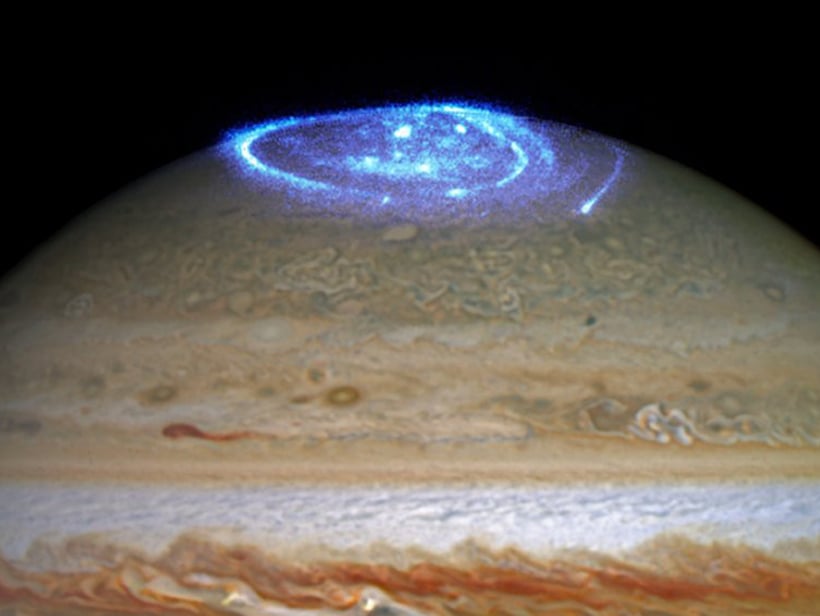
Unlike Earth’s northern and southern lights, Jupiter’s auroras are invisible to the naked eye. They glow only in ultraviolet and infrared wavelengths, their colors and patterns shaped by the planet’s immense magnetic field and low-density polar plasma. During a historic close pass over Jupiter’s north pole, NASA’s Juno spacecraft collected data that allowed scientists to peer into this hidden world for the first time.
“These are waves unlike anything we’ve ever seen in planetary auroras,” explains Dr. Ali Sulaiman, assistant professor of physics and astronomy at the University of Minnesota. “The extremely low frequency and behavior of the plasma suggest a new regime of magnetospheric dynamics.”
The discovery hinges on how Jupiter’s charged particles—ions and electrons ripped from their atomic nuclei—interact with its powerful magnetic field. On Earth, auroral activity forms a ring around the poles, but on Jupiter, the magnetic configuration channels particles directly into the polar cap, creating a more chaotic and concentrated auroral display. It is within this intense environment that the novel plasma waves appear, rippling through the polar plasma in patterns previously unobserved anywhere in the solar system.
Professor Robert Lysak, a plasma dynamics expert and co-author of the study, emphasizes the broader significance: “Studying these waves gives us clues about the fundamental physics of plasma under extreme magnetic conditions. It also informs our understanding of how planetary magnetic fields can protect atmospheres from harmful solar and cosmic radiation.”
The findings, published in Physical Review Letters, are just the beginning. As Juno continues its mission, researchers hope to capture more detailed observations of these waves, mapping how they interact with Jupiter’s atmosphere and magnetosphere over time. The ultimate goal is not only to understand the largest planet in our solar system but also to apply these insights closer to home, improving models of how Earth’s magnetic shield safeguards life from the sun’s energetic particles.
“Jupiter’s auroras are more than beautiful light shows—they are a laboratory for extreme physics,” says Sulaiman. “Every new discovery there helps us better grasp the invisible forces shaping planetary environments across the cosmos.”