Imagine hurtling through space at tens of thousands of kilometers per hour, targeting a rocky object the size of a small mountain, knowing that the slightest miscalculation could send it hurtling back toward Earth years later. This is the high-stakes challenge facing planetary defense scientists working on asteroid deflection.
Recent research presented at the EPSC-DPS 2025 Joint Meeting in Helsinki reveals that successfully nudging a hazardous asteroid requires more than brute force—it demands precision, patience, and a detailed understanding of the asteroid’s “gravitational keyholes.” These tiny regions of space, where planetary gravity can twist an asteroid’s path onto a future collision course with Earth, are the hidden traps in our cosmic neighborhood.
Rahil Makadia, a NASA Space Technology Graduate Research Fellow at the University of Illinois at Urbana-Champaign, explained the stakes: “Even if we intentionally push an asteroid away, we must ensure it doesn’t drift into one of these keyholes. Otherwise, the threat returns, potentially decades later.”
The DART mission in 2022 proved that kinetic impactor strategies work, successfully nudging Dimorphos, a small asteroid orbiting Didymos. But for asteroids not paired in a benign system like Didymos, a careless strike could send the object through a keyhole, setting up a future disaster.
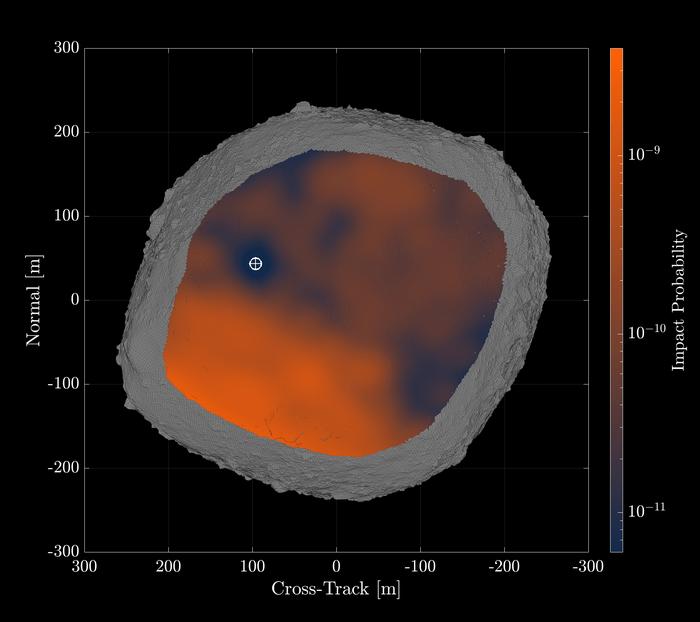
Makadia and his team have developed a cutting-edge method to identify the safest deflection zones on an asteroid’s surface. Each point is mapped with a probability of pushing the asteroid toward—or away from—a gravitational keyhole. Factors like the asteroid’s shape, rotation, mass, and surface features—hills, craters, and ridges—must all be carefully considered. Ideally, high-resolution data from a rendezvous mission would guide this analysis, but in urgent cases, ground-based observations alone can provide a preliminary map.
The implications are enormous. With precise targeting informed by these probability maps, planetary defense teams can plan kinetic impact missions that not only divert the asteroid but minimize the risk of creating a future threat. It’s a delicate balance of celestial mechanics, physics, and risk management—a cosmic chess game played millions of kilometers from Earth.
Makadia sums it up simply: “With these probability maps, we can push asteroids away while preventing them from returning on an impact trajectory, protecting the Earth in the long run.”
As asteroid detection and deflection technologies advance, these techniques may soon become standard in safeguarding our planet. And when the next hazardous asteroid is spotted, scientists will know exactly where to strike to keep Earth out of harm’s way.