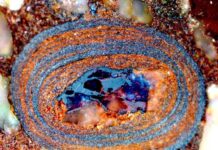
In a dim laboratory in Boulder, Colorado, a patch of liquid crystals has begun to move—slowly, rhythmically, endlessly. No batteries, no motors, no outside force driving the dance. Just light. What looks like a shifting pattern of psychedelic stripes is, in fact, something physicists once thought impossible: a time crystal that the human eye can actually witness.
The breakthrough, reported in Nature Materials, marks a first in a field that has long been the domain of theory, quantum mechanics, and computer simulations. For the first time, researchers say, the concept of a “time crystal” has broken free from physics jargon and become something you can literally watch unfold under a microscope.
A Living Clockwork
Time crystals are not ordinary matter. Instead of sitting still or reaching equilibrium, their particles cycle endlessly, repeating patterns as if locked in a perpetual loop. Think of a clock whose gears spin forever without winding or power.
“This is matter that moves with its own rhythm,” said Hanqing Zhao, a doctoral researcher at the University of Colorado Boulder and lead author of the study. “And for the first time, you don’t need a supercomputer to confirm it. You can see it directly.”
The team used glass cells filled with rod-shaped liquid crystal molecules—materials better known for powering smartphone displays. With the right preparation and a beam of light, the molecules began to twist and flow, forming rippling patterns that sustained themselves for hours.
From Theory to Sight
The notion of time crystals was first floated in 2012 by Nobel Prize–winning physicist Frank Wilczek, who wondered whether crystals could be organized not just in space but in time. Atoms in a diamond, for example, sit in a repeating lattice. In a time crystal, the “repetition” would not be spatial but temporal—a loop of motion without end.
Wilczek’s exact design proved unattainable. But over the last decade, variations have emerged, including exotic experiments on quantum computers. Those results, while groundbreaking, were visible only through complex data readouts.
What sets the Colorado group’s work apart is accessibility: a time crystal you can place under a lens and observe, its strange, restless order revealed by light. Under some conditions, researchers say, the patterns are even visible to the naked eye.
Why It Matters
The discovery is more than a curiosity. Because the crystals operate far from equilibrium, they could lead to new classes of devices that harness self-sustaining motion. Potential applications range from energy-efficient displays to advanced computing systems and materials that adapt in real time.
“All you do is shine a light,” said Ivan Smalyukh, senior author and physics professor at CU Boulder. “And out of nothing, this entirely new world of time crystals comes alive.”
The researchers are part of an international network, the WPI-SKCM2 initiative, dedicated to inventing novel forms of matter with an eye toward sustainability. Their work suggests that time crystals might move beyond abstract theory and into the toolkit of practical materials science.
The Rhythm of Forever
Watching one of these liquid crystal samples in motion, it’s easy to see why physicists are captivated. The looping patterns resemble an endlessly cycling GIF, a microscopic ballet immune to fatigue.
If ordinary crystals are frozen perfection, time crystals are their restless cousins—always in motion, forever keeping time with themselves. And now, for the first time, humans can witness them directly.