The cosmos just got a little more intimate. For the first time, we can soar above the Milky Way, tracing its spiraling arms and peering into stellar nurseries, all without leaving Earth. Thanks to the European Space Agency’s Gaia mission, astronomers have stitched together the most precise 3D map of our galaxy ever created, revealing the Milky Way not from within, but from a cosmic vantage point.
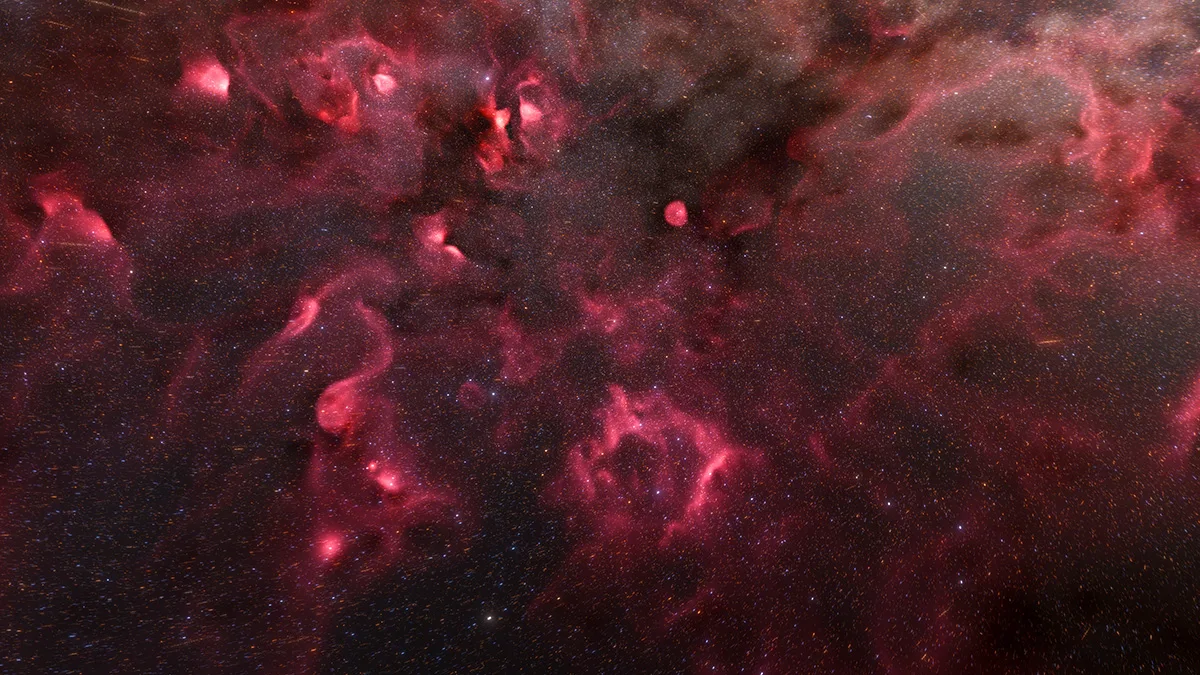
Launched in December 2013, Gaia meticulously tracked the positions, motions, and brightness of over a billion stars. The mission concluded in January 2025, leaving behind a treasure trove of data that scientists have now transformed into stunning 3D animations. These visualizations let us virtually fly through star-forming regions, highlighting clouds of ionized hydrogen gas where newborn stars ignite their first nuclear fires.
Among the 44 million “ordinary” stars mapped, Gaia also tracked 87 rare, massive O-type stars. These stellar powerhouses emit fierce ultraviolet light, sculpting the surrounding gas and illuminating the Milky Way’s structure in ways previously unimagined. The result is a galaxy that is both familiar and astonishingly new—a swirling, dynamic ecosystem of stars, dust, and radiation revealed in unprecedented detail.
The animations provide more than just visual spectacle. They allow astronomers to study the intricate interactions between stars and the interstellar medium. Researchers can see how radiation from massive stars carves cavities in surrounding clouds, how dust drifts and interacts with gas, and how the local galactic environment evolves over time. Objects like the Orion-Eridanus superbubble, the Gum Nebula, and the North America Nebula are rendered in lifelike 3D, giving a sense of scale and movement impossible to achieve from ground-based or even space telescopes alone.
Crucially, Gaia’s 3D maps offer the first realistic “top-down” view of our galaxy from the outside. Until now, we could only infer the Milky Way’s structure indirectly, through radio, infrared, and optical observations from within the galactic disk. Now, scientists can explore a digital recreation of our corner of the galaxy, observing how stars and clouds align, cluster, and drift in a complex cosmic dance.
Despite covering just 4,000 light-years from the Sun, the new map is a computational triumph, blending precise stellar positions with the obscuring effects of interstellar dust. The effort has laid the groundwork for even larger-scale mapping, promising future vistas that could encompass tens of thousands of light-years and bring the full spiral of the Milky Way into sharp focus.
As Gaia’s next data release approaches, astronomers anticipate even finer detail and richer insights into the processes that shape our galaxy. For now, the ability to take a virtual flight above the Milky Way offers a rare perspective: we are no longer just stargazers on a pale blue dot—we are spectators of a galaxy in motion, witnessing the architecture of the cosmos as if from a distant, interstellar perch.