
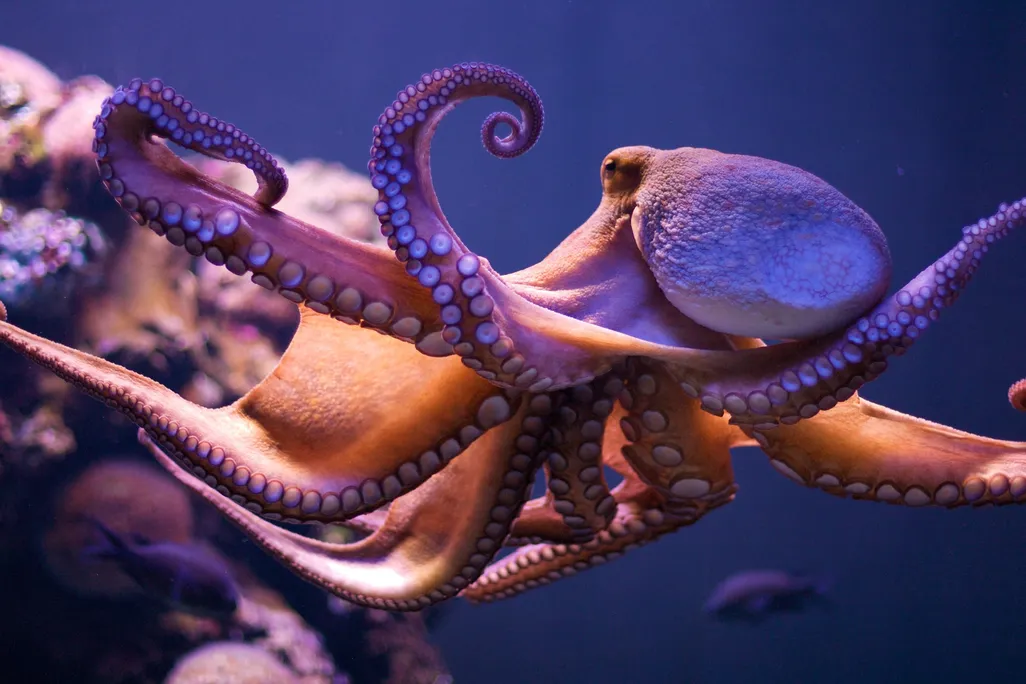
In the turquoise shallows of the Caribbean and the rocky coasts of Spain, researchers have captured an extraordinary underwater spectacle: wild octopuses flexing their eight arms in ways that defy imagination.
This isn’t just another marine curiosity. For the first time, scientists have linked the minute movements of octopus arms to full-body behaviors in natural habitats — offering a window into the daily survival strategies of one of the ocean’s most mysterious invertebrates.
A team from Florida Atlantic University, working with colleagues at the Marine Biological Laboratory in Woods Hole, Massachusetts, spent months documenting these secretive animals in six distinct environments. They returned with nearly 4,000 catalogued arm movements from three species, spread across 25 video recordings. The result is a sweeping look at how octopuses actually use their limbs when no aquarium glass or lab tank restricts them.
Front vs. Back: A Division of Labor
Not all arms are created equal. While each of the eight is capable of any movement, the study found a distinct pattern: front arms take on exploratory roles, probing the environment or searching for food, while back arms provide the power for locomotion.
The arms aren’t just moving independently — they coordinate with astonishing complexity. A single limb can bend and twist simultaneously, while others elongate or contract in unison, creating a ballet of motion that allows octopuses to crawl, lunge, or stage the infamous “parachute attack,” where they engulf prey in a sudden pounce.
Specialists at Every Segment
Closer analysis revealed that different regions of each arm serve specialized functions. The tips are most likely to bend, while segments closer to the body elongate to push or reach. Altogether, researchers observed nearly 7,000 deformations, classified into four fundamental types: bending, shortening, elongating, and torsion.
“Watching them in the wild, we were struck by the range of behaviors a single arm could perform,” said Chelsea Bennice, lead author and research fellow at FAU. “Sometimes one limb was enough for delicate tasks, while other times, multiple arms worked together like a well-rehearsed team.”
A Toolkit for Survival
The arms’ versatility extends beyond hunting. Octopuses use them to disguise themselves — blending into coral as “moving rocks” or drifting like seaweed. They build dens, battle rivals, and fend off predators, relying on their arms as both tools and weapons.
“It takes patience, grit, and a lot of luck to see authentic octopus behavior in the field,” noted co-author Roger Hanlon, a senior scientist at Woods Hole. “But it’s the only way to truly understand their sensory world.”
From Ocean Depths to Human Innovation
The implications reach far beyond marine biology. Insights into octopus arm control are already fueling ideas in neuroscience and robotics. Engineers studying soft robotics look to octopuses as models for machines that can flex, grip, and adapt in ways rigid structures cannot.
For now, the octopus remains a reminder of how much we still don’t know about the living systems beneath the waves. Each arm, with its endless adaptability, holds secrets that could reshape our understanding not just of marine life, but of movement itself.