
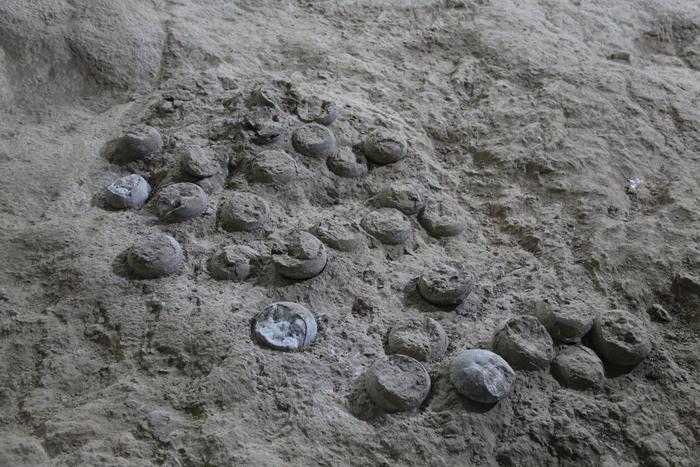
Deep in central China, fossilized dinosaur eggs have quietly guarded a story of Earth’s distant past for tens of millions of years. Now, for the first time, scientists have pinned an exact date on them—85 million years old—unlocking fresh insights into the climate and environmental challenges dinosaurs faced in the Late Cretaceous.
The eggs come from Qinglongshan, China’s first national dinosaur egg fossil reserve, where more than 3,000 eggs are preserved across three sites. Embedded in a mix of breccia and siltstone, many of the eggs remain in their original positions, remarkably intact after millions of years. The majority belong to a single species, Placoolithus tumiaolingensis, whose porous eggshells hint at evolutionary adaptations to the planet’s shifting climate.
Using carbonate uranium-lead (U-Pb) dating, the researchers treated the eggs themselves as timekeepers. By vaporizing minute samples of calcite in the eggshell with a micro-laser, they measured the decay of uranium into lead, producing a precise “atomic clock” for the fossils. This method eliminates uncertainties that come from dating surrounding rock layers, delivering the first robust chronological record of Qinglongshan’s dinosaur eggs.
“These eggs were laid during a period of significant climate change,” explained Dr. Bi Zhao of the Hubei Institute of Geosciences. “Global temperatures had begun to cool, affecting dinosaur populations and possibly shaping how eggs were laid and preserved.” The study suggests that Dendroolithidae eggs, with their specialized pore structures, may have evolved as a response to this cooler, shifting climate—a rare glimpse at adaptation in deep time.
The findings not only refine the timeline of dinosaur reproduction but also shed light on environmental pressures during the Late Cretaceous. As Zhao notes, “By precisely dating these eggs, we can link fossil records to climate events, creating a clearer picture of Earth’s history and the challenges faced by dinosaurs.”
Future research will expand the analysis to eggs from other rock layers and nearby basins, potentially tracing patterns of dinosaur migration and extinction. For now, these 85-million-year-old eggs are more than just fossils—they are tiny capsules of a prehistoric world, offering a snapshot of life on a planet very different from today, yet connected to the same forces that shape life on Earth.