
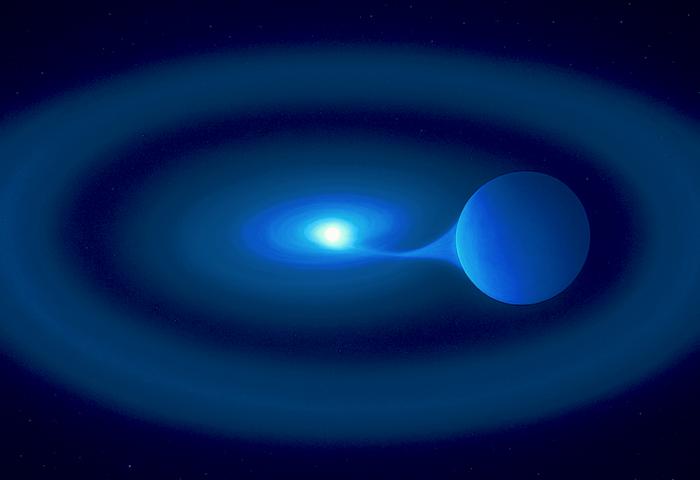
Far beyond the reach of our solar system, a cosmic drama is unfolding that could soon light up our night sky like never before. V Sagittae, a binary star system located about 10,000 light-years from Earth, is currently engaged in a furious celestial tango. At its center, a ravenous white dwarf is feasting on its larger companion, a process so extreme that astronomers are calling it unprecedented.
The white dwarf, a dense stellar remnant left behind when a star dies, is siphoning mass from its partner at an astonishing rate. This material spirals onto the white dwarf’s surface, igniting thermonuclear reactions that turn the system into a blazing beacon, visible even across the vast expanse of space.
“This isn’t just any star system,” says Professor Phil Charles of the University of Southampton. “V Sagittae has baffled astronomers for more than a century, but our observations finally explain its extreme brightness—it’s a star literally consuming its twin.”
Orbiting each other every 12.3 hours, the stars are locked in a deadly dance. As the white dwarf strips matter from its companion, it cannot absorb it all. Instead, the overflow forms a luminous ring of gas encircling both stars, a cosmic halo born of the stellar feast. The halo not only amplifies the system’s brightness but offers astronomers rare insight into the mechanics of stellar consumption.
Dr. Pasi Hakala from the University of Turku, lead author of the study, describes the system as “a frantic signal of its impending, violent end.” Researchers warn that within years, V Sagittae could produce a nova outburst bright enough to be seen with the naked eye. And the finale promises to be even more spectacular—a supernova explosion that could rival the brightness of the daytime sky on Earth.
The findings, published in the Monthly Notices of the Royal Astronomical Society, were made possible by the European Southern Observatory’s Very Large Telescope in Chile. Dr. Pablo Rodríguez-Gil of Spain’s Instituto de Astrofísica de Canarias adds, “The scale of matter transfer and the resulting energy release in this system challenges our understanding of how stars evolve and die.”
For now, astronomers and stargazers alike are keeping a close watch on V Sagittae, a cosmic spectacle unfolding in real time. What started as a centuries-old mystery is quickly becoming one of the most thrilling astronomical stories of our generation—a stark reminder that the universe is as violent as it is beautiful.