
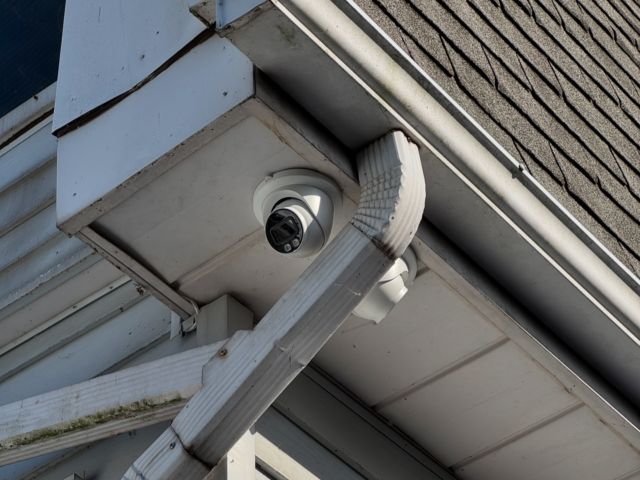
On a stretch of MacNab Street North in downtown Hamilton, the glow of ten security cameras keeps watch. Mounted on the home of Dan Myles, the cameras have become both a shield against crime and a flashpoint in a growing debate over where safety ends and privacy begins.
Myles insists the cameras are not only for his own protection but also for the wider community. “We’ve had break-ins, not just here, but up and down the block,” he said, recalling how footage from his system has helped him—and at times, others—make sense of what was happening in the shadows. His videos have captured car crashes, suspected break-and-enters, and street-level disturbances. In at least one instance, footage was broadcast on local television news.
Yet last week, the City of Hamilton ordered him to take all ten cameras down. The reason: his home surveillance violates the city’s fortification by-law, which prohibits property owners from recording or monitoring activity beyond the limits of their own lot.
A Clash of Principles
The order has put Myles at the centre of a collision between two deeply held values—community safety and individual privacy.
“I couldn’t believe it,” Myles said. “Everyone around here has Ring doorbells pointing onto the street. My neighbours have cameras facing my house. We’re all watching each other. Why am I the one being told to stop?”
His frustration is echoed by some neighbours. Jane Yates, who lives nearby, says the cameras provide a sense of reassurance in a neighbourhood struggling with petty crime. “Dan’s gone above and beyond to protect us,” she said. “We’ve been hit hard, and having extra eyes on the street matters.”
But not everyone agrees. Privacy advocates argue that a street blanketed in private surveillance is a slippery slope. Ann Cavoukian, Ontario’s former Privacy Commissioner, is blunt: “Filming everyone without their consent is unacceptable. Privacy isn’t just a preference—it’s a foundation of our freedom. You can monitor your property, yes, but you must respect the public space around it.”
The Law Behind the Order
Hamilton’s fortification by-law was created to regulate how much residents can fortify their homes against crime. Initially, it was a tool to discourage fortified drug houses, which were often turned into near-impregnable compounds. But the law also extends to surveillance equipment—restricting any camera that peers beyond the homeowner’s boundary.
City officials confirmed that Myles has been asked to comply, but declined to comment further, citing an active investigation.
For Myles, who has appealed the order, the rules seem out of step with modern life. “We’re in a time where everybody documents everything,” he said. “If I’m helping police with evidence and keeping the neighbourhood safer, shouldn’t that count for something?”
The Police Position
Hamilton police have not directly confirmed whether they’ve used Myles’ footage in investigations, though they frequently request video from residents, businesses, and even drivers when looking for evidence. Myles maintains that officers have asked him for clips more than once.
This gap between what residents perceive and what authorities officially acknowledge fuels mistrust. If the city enforces the by-law too strictly, critics say, it risks alienating residents who see themselves as partners in community safety.
A Larger Question
Myles’ case is not just about one house on one street. It reflects a broader societal tension: in a world where technology allows nearly anyone to surveil their surroundings, who gets to draw the line?
On one hand, doorbell cameras and dashcams have become staples in police investigations, often providing key evidence in everything from thefts to fatal accidents. On the other, unchecked surveillance risks creating neighbourhoods where no one can step outside without being recorded.
As Cavoukian put it, “There has to be balance. Security is important, but privacy is non-negotiable. One cannot come at the expense of the other.”
What Happens Next
Myles is waiting to hear back on his appeal. In the meantime, the cameras remain, and so does the unease. His supporters see him as a community guardian, his critics as a boundary-crosser.
What’s clear is that the dispute is forcing Hamilton to reckon with questions that extend far beyond a single by-law: How much surveillance is too much? Who should control it? And when the goals of safety and freedom collide, which one prevails?
For now, the cameras on MacNab Street continue their silent vigil—symbols of both protection and intrusion, depending on who you ask.