
The scene is all too familiar: someone collapses in a crowded park, on a hiking trail, or in a quiet village miles from the nearest hospital. Panic sets in, bystanders call for help, but minutes feel like hours as they wait for an ambulance. In cardiac arrest, every passing minute without defibrillation slashes the chance of survival.
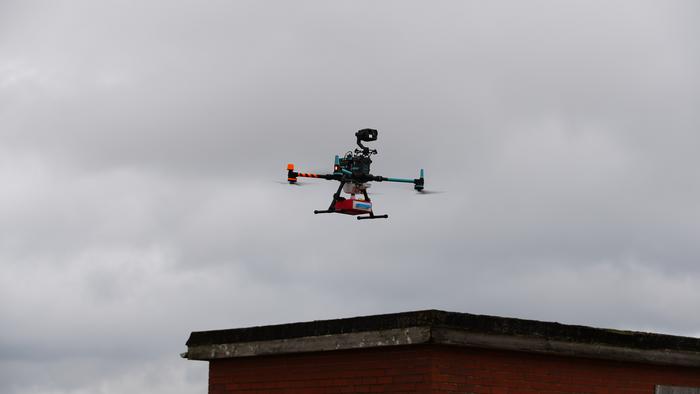
Now imagine instead: the whir of propellers grows louder overhead. A small drone hovers above, lowers a bright yellow defibrillator by cable, and within moments, strangers on the ground are guided to deliver a lifesaving shock—well before an ambulance even arrives.
This isn’t science fiction. It’s the future British researchers are actively preparing for.
A New Lifeline From the Sky
Each year, more than 40,000 people in the UK suffer out-of-hospital cardiac arrests. Fewer than one in ten survive. The single biggest factor in survival? Time. Defibrillation within minutes can double or even triple the chance of survival, but AEDs (Automated External Defibrillators) are often hard to find—or too far away to matter.
A team from the University of Warwick, working with the Welsh Ambulance Services NHS Trust and drone specialists SkyBound, has taken a bold step toward changing that equation. Their study, backed by the National Institute for Health and Care Research (NIHR), tested whether drones could be dispatched as quickly as emergency calls are made.
The results suggest they can.
Simulations in the Countryside
The researchers staged cardiac arrest scenarios in remote rural locations—places where ambulances often struggle to arrive quickly. In these drills, a DJI M300 drone fitted with a winch carried an AED directly to the scene. Volunteers acted as bystanders, guided by emergency call handlers in real time.
The system performed well: from the moment a 999 call was placed, the drone took off in just over two minutes. It flew autonomously, kept a steady link with emergency services, and delivered its payload safely to the ground.
Participants, though initially cautious, adapted quickly to the sight of a medical device descending from the sky. But once the AED was in hand, things became more complicated. Even with instructions, many struggled with setup and use, highlighting that drone delivery alone isn’t enough—the human factor remains critical.
Stories That Underscore the Stakes
For some, the idea isn’t abstract. Steve Holt, a retired surgeon, knows how unforgiving the clock can be. He suffered two cardiac arrests while hiking in the Lake District. His son Mark kept him alive with CPR until help arrived—but weather grounded an air ambulance, and road paramedics took 25 minutes to reach them. “It felt like an eternity,” Mark recalled.
For him, the potential of drones isn’t just exciting—it’s deeply personal. “A drone carrying a defibrillator could have been the difference between life and death,” he said. Today, he contributes to the Warwick study as a patient representative.
The Road Ahead
While promising, the technology still has hurdles. The study revealed delays once the AED was on-site, with over four minutes passing before a simulated shock was delivered. Researchers concluded that better support for bystanders—and improved AED usability—are essential for drone systems to be truly effective.
Still, experts are optimistic. Professor Mike Lewis of the NIHR called cardiac arrest “one of the biggest killers” and praised the drone program as a showcase of how high-tech solutions can strengthen public health.
A Future in Reach
The vision is compelling: drones dispatched alongside ambulances, arriving in minutes, carrying the tools to restart a heart. For now, larger trials and funding are needed before the system can scale nationally. But the study proves the idea is not just viable—it’s within grasp.
If adopted, the whirring of drone propellers may one day become as familiar as the wail of an ambulance siren. And in those first, fragile minutes of cardiac arrest, that sound could mean the difference between tragedy and survival.