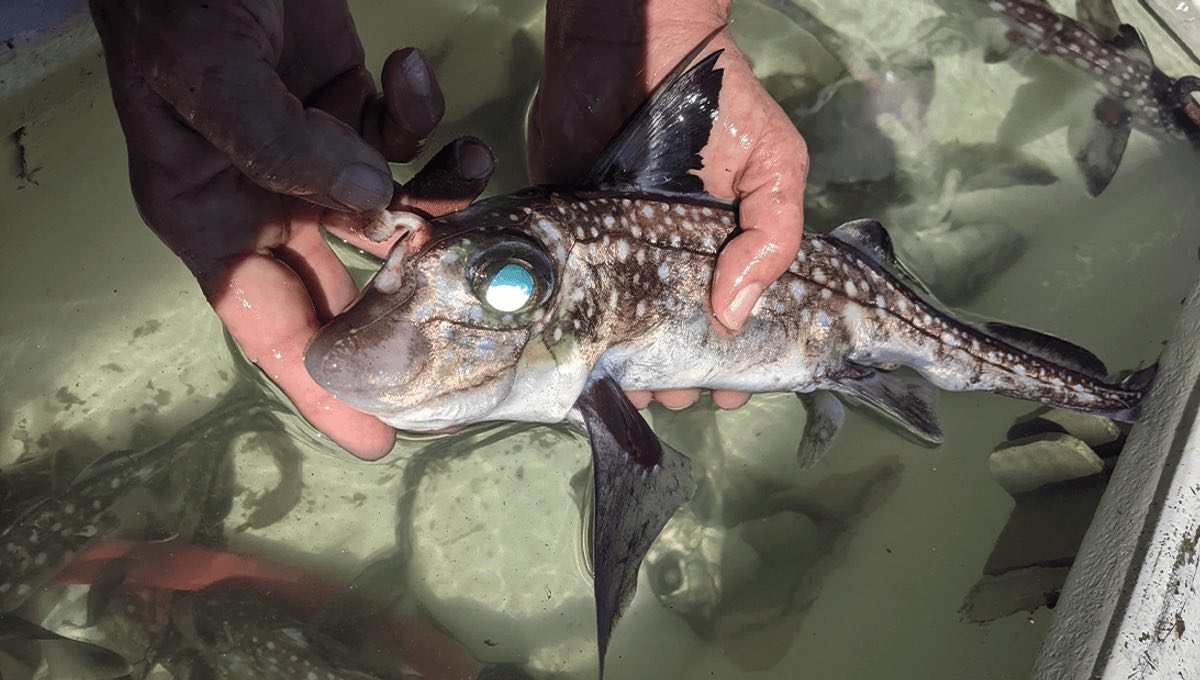
In the shadowy depths of the ocean, evolution has taken a decidedly strange turn. Male ghost sharks—ethereal, deep-sea chimaeras related to sharks and rays—sport a bizarre forehead appendage bristling with sharp, retractable teeth. Far from a decorative oddity, researchers now believe these “forehead teeth” are a critical tool in mating, revealing an astonishing example of evolutionary innovation.
The discovery, detailed in Proceedings of the National Academy of Sciences, sheds light on a feature previously overlooked in these elusive creatures: the tenaculum, a rod jutting from the male’s forehead. Unlike the ordinary teeth inside the mouth, this appendage bears true teeth genetically identical to oral teeth, used to grasp females during reproduction.
“This isn’t just a freaky adaptation,” said Gareth Fraser, Ph.D., a professor at the University of Florida and senior author of the study. “It’s a vivid example of how evolution can repurpose existing structures to solve reproductive challenges in entirely new ways.”
The research combined observations of modern Spotted Ratfish (Hydrolagus colliei) with fossil analysis, revealing that the tenaculum’s tooth rows have ancient origins. A 315-million-year-old fossil shows a similar appendage attached to the upper jaw, hinting that this unique adaptation has deep evolutionary roots. Genetic tests confirmed that the tenaculum teeth activate the same gene program as oral teeth, dispelling earlier theories that they might merely be tooth-like skin projections.
Dr. Karly Cohen, a postdoctoral researcher at the University of Washington, described the significance: “We now have the first clear evidence of teeth developing outside the mouth in a vertebrate. The tenaculum isn’t an evolutionary fluke—it’s a functional, reproductive tool.”
Modern imaging techniques, including CT scans of live specimens, allowed the team to visualize the full complexity of the teeth-laden appendage. Michael Coates, Ph.D., from the University of Chicago, emphasized the evolutionary ingenuity at play: “This is a textbook case of evolutionary tinkering. Nature co-opted a preexisting genetic program to create an entirely new structure essential for survival and reproduction.”
Beyond the scientific novelty, the finding underscores the hidden diversity of life in our oceans. These ghost sharks, rarely seen by humans, demonstrate the lengths to which evolution will go to solve the age-old challenge of passing on genes. The tenaculum’s development is a stark reminder that the deep sea still harbors countless evolutionary mysteries waiting to be unraveled.
“Every time we think we’ve mapped the boundaries of life, the ocean surprises us,” Fraser said. “The forehead teeth of ghost sharks show that even the most bizarre adaptations can have a precise, functional purpose.”
As scientists continue to explore the depths, such discoveries hint at how flexible and inventive evolution can be, reshaping the familiar into the extraordinary, and turning the impossible into reality.