
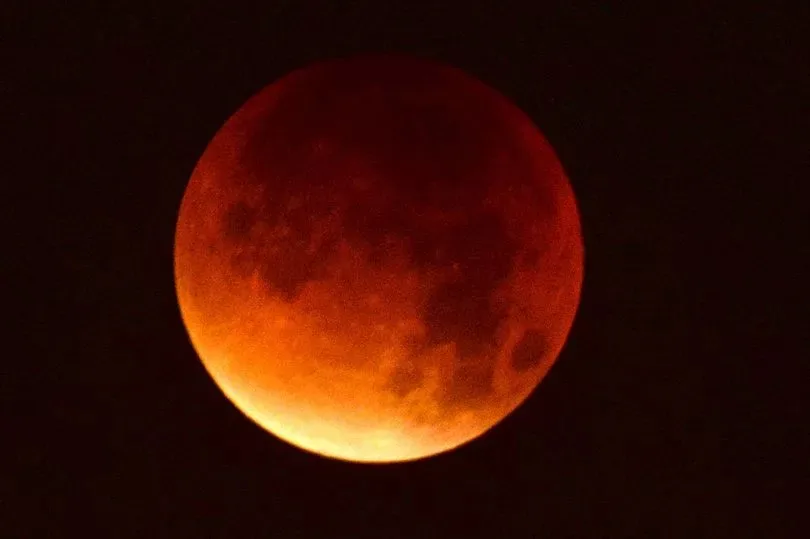
On Sunday evening, the UK will look up to a sky staging one of nature’s rarest spectacles: a total lunar eclipse, the kind that turns the familiar silver face of the Moon into a deep, eerie red. For many Britons, it will be the first chance in years to witness the celestial event often nicknamed the “Blood Moon.”
Unlike meteor showers that streak suddenly across the night or northern lights that can appear without warning, eclipses announce themselves well in advance. They are predictable, calculated to the minute, and yet — when they finally unfold — they feel anything but ordinary.
Why This Eclipse Matters
The last time a total lunar eclipse was visible in the UK was in 2022. Since then, observers have only had partial views of the phenomenon. This weekend’s event is significant not only because of its rarity, but also because of its visibility: the timing means that millions of people won’t need to stay up until the early hours to see it.
At 7:11pm BST, the Moon will reach maximum eclipse — though still below the horizon for the UK. By the time it climbs into view, it will already be glowing red, lingering low in the east until about 9:55pm.
The Science Behind the Blood Moon
So what exactly transforms the Moon into that rust-colored disk? During a total lunar eclipse, Earth slides perfectly between the Sun and the Moon. Our planet’s shadow falls across the lunar surface, but instead of disappearing into darkness, the Moon glows red.
That glow is Earth’s doing. Sunlight bends through our atmosphere, filtering out blues and greens, before refracting onto the Moon. It’s the same effect that paints our sunsets orange and red — only this time, it colors the entire lunar landscape.
How It Differs From a Solar Eclipse
Lunar eclipses often get confused with their solar cousins, but the mechanics — and the viewing experience — are completely different. A solar eclipse occurs when the Moon itself blocks the Sun, casting a narrow shadow on Earth. You need to be in the right place at the right time to see it.
A lunar eclipse, by contrast, is generous. Anyone on the night side of Earth can watch the show unfold, no glasses required. That’s why astronomers often call them “the people’s eclipse.”
Where and How to Watch in the UK
This Blood Moon will favor those with a clear eastern horizon. Because the Moon will be low, finding an elevated spot — a hill, an open field, or even a rooftop terrace — will make all the difference. In cities, tall buildings can easily block the view.
For the clearest skies, eastern regions of the UK will enjoy the longest visibility. But even a fleeting glimpse, if clouds cooperate, will be worth it. Photographers are already preparing their lenses, though smartphone users can also capture striking images if they steady their devices against a wall or tripod.
A Cosmic Pause in Everyday Life
Eclipses have always stirred awe and imagination. Ancient civilizations saw them as omens, while poets found metaphors in the darkened Moon. Today, even in a world awash with artificial light and constant distraction, a total lunar eclipse has the power to stop people in their tracks — a reminder that the universe still has its rhythms, far beyond our control.
The next chance for the UK to see a lunar eclipse won’t come until August 2026 — and that one will only be partial. Sunday’s Blood Moon, then, is more than just a date on the astronomical calendar. It is a fleeting moment, a cosmic performance, and for those willing to look up, a rare kind of beauty written across the sky.